Settings
 Fast Delivery
 Payment Types


 Marketplace Product

Antimicrobial Metal-Detectable Cable Ties for Food, Beverage, and Pharmaceutical Production
Contributed By DigiKey's North American Editors
2026-10-01
Technical Overview: Food and pharmaceutical production requires cable management components that support hygiene, contamination control, and reliable operation. This article reviews Panduit antimicrobial metal-detectable cable ties and mounts, combining durable Nylon 6.6 construction with antimicrobial additives and metal detectability to help manufacturers reduce microbial growth and identify fragments while meeting demanding production requirements. (Overview courtesy of ChatGPT)
Food and pharmaceutical manufacturing facilities operate under some of the tightest regulations in the production sector. Because the finished products are directly ingested or injected, safety and hygiene are nonnegotiable across the entire production process, covering both procedures and equipment. As a result, every piece of hardware, from large industrial machinery to much smaller unassuming fixtures such as cable ties, is subject to several standards and regulations.
Cable ties are a simple yet critical component in production facilities. These fasteners organize power and signal cables; secure pneumatic lines, hoses, and sensor leads; provide strain relief at connectors; keep wiring away from moving machinery; and, when paired with mounts, anchor bundles to surfaces. Due to their versatility and functionality, cable ties are ubiquitous on production lines. This ubiquity often places them in proximity to the product stream in food and pharmaceutical manufacturing. As a result, cable ties for food processing must possess specific properties to meet the strict safety, hygiene, and contamination-control demands of these industries.
Meeting critical manufacturing requirements
Conventional cable ties, which are generally adequate on a factory floor, do not meet the demands of these environments as stipulated by broader regulatory frameworks. The U.S. Food and Drug Administration (FDA) 21 CFR Part 117 requires facilities to conduct a hazard analysis covering biological, chemical, and physical hazards and to implement preventive controls against them. It requires that plant equipment, including equipment in food-production areas that does not have contact with food, be adequately cleanable, maintained to protect against contamination, and designed to avoid introducing contaminants, such as metal fragments.
European Union Regulation (EC) No 852/2004 also requires European food businesses to apply HACCP (Hazard Analysis Critical Control Point) procedures throughout production, part of which mandates that articles and equipment be constructed from suitable materials and kept in a condition that minimizes the risk of contamination and allows effective cleaning.
Pharmaceutical regulations, such as FDA 21 CFR 211.63, stipulate similar rules, requiring that equipment used in the manufacture, processing, packing, or holding of a drug product be of appropriate design and suitably located to facilitate both its intended use and its cleaning and maintenance. These regulations directly and indirectly translate into several requirements for food-grade cable ties, one of which is durability.
Production environments can expose cable ties to continuous mechanical loading, heat, moisture, vibration, temperature variations, and various chemicals, which can degrade them over time. A tie that becomes brittle, loosens, or breaks can release the cable or hose it was securing, leading to unplanned downtime. Damaged cable ties can also create contamination and sanitation risks through broken fragments and abraded surfaces. Therefore, cable ties for pharmaceutical manufacturing and food processing must be rugged enough to withstand the strenuous environment of production lines.
While required in safety-critical industries, durability is also generally necessary in most production lines. One particularly important requirement in food, beverage, and pharmaceutical manufacturing is resistance to microbial growth. Processing areas are typically warm, humid, and full of organic residue—excellent conditions for microbes to thrive. These conditions require cable ties around the production line to have effective antimicrobial properties, whether or not they are in direct contact with the product. Antimicrobial cable ties support safety and hygiene by inhibiting microbial growth on their own surfaces, as components that support growth become harborage points for the surrounding zone.
Another critical requirement of food-grade cable ties is detectability. Even the most durable ties are not completely immune to damage. If a cable tie breaks during regular operation or maintenance, a fragment can enter the process stream. In conventional plastic cable ties, the material offers no way to detect fragments quickly, allowing them to end up in finished products. U.S. Department of Agriculture Food Safety and Inspection Service (FSIS) data for 2025 ranked foreign material as the leading cause of recalls, accounting for 13 of 42 recalls issued that year. Metal-detectable cable ties solve this problem by incorporating metallic material into the polymer. This allows appropriately configured metal-detection equipment along the production line to detect any cable tie fragments that enter the process stream.
In addition to these requirements, cable ties for the food, pharmaceutical, and healthcare industries must meet several standards set by various quality, food and drugs, health and safety, and manufacturing organizations. Food-grade cable ties must therefore combine durable construction, antimicrobial protection, metal detectability, and compliance with various standards. Panduit offers a range of antimicrobial, metal-detectable cable ties and mounts designed to meet these requirements.
Antimicrobial metal-detectable cable ties and mounts
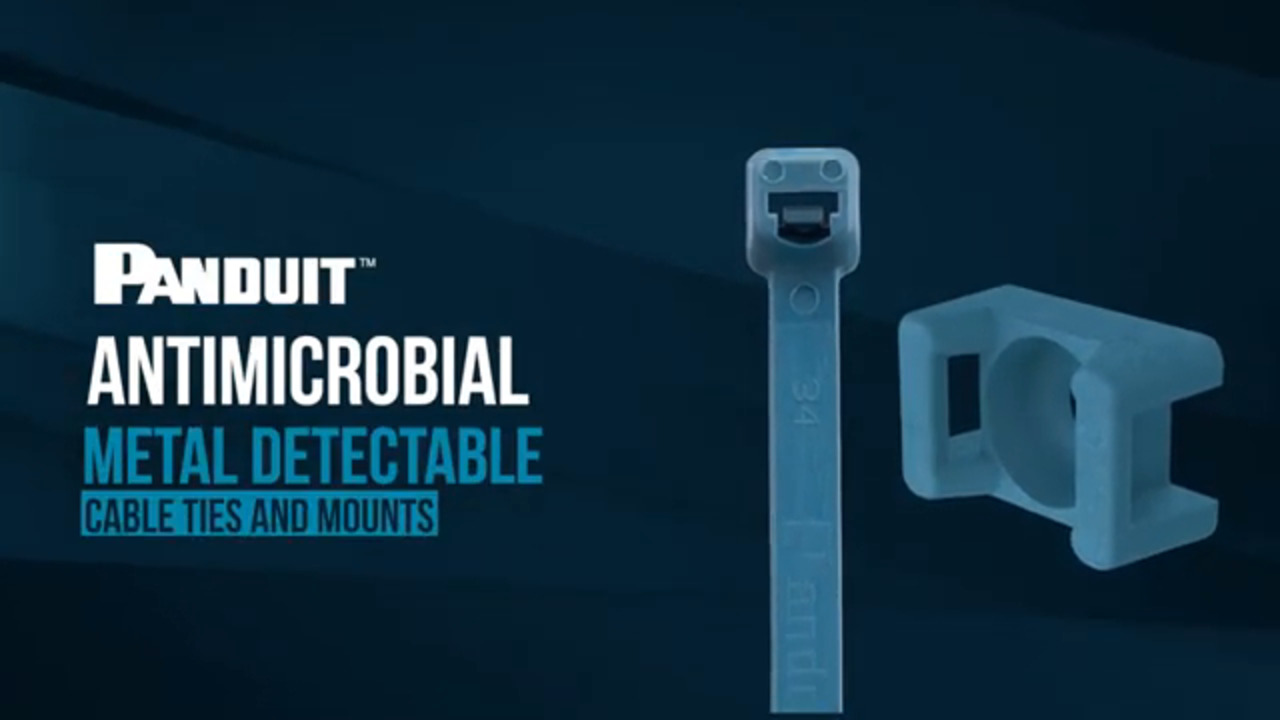
Panduit’s antimicrobial metal-detectable fasteners comprise one-piece locking Nylon 6.6 cable ties and screw-applied mounts for food, beverage, pharmaceutical, healthcare, and other safety- and hygiene-critical facilities. The products comply with FDA HACCP standards and EU hygiene monitoring regulations and are available in different sizes and ratings.
Panduit achieves antimicrobial protection by molding U.S. Environmental Protection Agency (EPA)-registered antimicrobial additives directly into the plastic resin, ensuring that protection extends beyond the cable tie surface. The company says independent laboratory testing under ISO 22196 and ASTM G21 verified inhibition of bacteria, mold, and fungi on the cable tie surface.
The Nylon 6.6 construction also provides the mechanical and environmental performance required for industrial use. Panduit specifies a continuous-use temperature range of -40°C to +85°C (-40°F to +185°F) and 1.2% water absorption after 24 hours under ASTM D570. The fasteners are also adequately resistant to inorganic and organic acids, alkaline cleaners, disinfectants, and sanitizers.
Panduit offers cable ties with loop tensile strengths suited for a wide range of applications. The PLT1M-C96A, for example, is rated at 18 lb (8.16 kg), making it suitable for light wiring organization. Its heavy-duty counterpart, the PLT3H-L96A (Figure 1), can withstand up to 120 lb (54.43 kg) of tensile load in industrial applications. Intermediate food-grade cable ties rated 30 lb (13.61 kg) and 50 lb (22.68 kg), suitable for general cable and utility bundling, are available as well. The ties are available in various lengths and cross sections.
 Figure 1: The PLT3H-L96A has a loop tensile strength of 120 lb (54.43 kg) for heavy-duty industrial applications. (Image source: Panduit)
For detectability, Panduit implements two solutions. First, the cable ties are blue for easy visual detection, which is common industry practice for food-zone consumables, as this shade is rarely found in products, making a dropped tie or broken tip visible on a conveyor or in an open package. More importantly, the detectable cable tie is impregnated with metallic material, allowing standard metal-detection equipment to identify fragments. Panduit backs this feature with process control, ensuring that every production lot passes metal detection as part of final verification, while each package carries a quality-control number for product traceability. As with any metal-detectable zip tie, actual detection capability depends on the detector's validated sensitivity and the fragment's size and orientation.
The same combination of antimicrobial protection, metal detection, and durability also applies to the antimicrobial cable tie mounts in the portfolio. The TM2S8-C96A mount (Figure 2) accepts miniature, intermediate, and standard ties and is secured with a No. 8 (M4) screw. The larger TM3S8-C96A accommodates standard and light-heavy ties with the same screw size, while the TM3S10-C96A uses a No. 10 (M5) screw. The mounts use a low-profile cradle design to hold bundles securely while limiting the space required around equipment.
 Figure 2: The TM2S8-C96A mount accepts miniature, intermediate, and standard ties and mounts with a No. 8 (M4) screw. (Image source: Panduit)
Panduit lists the ties and mounts as compliant with applicable FDA HACCP and EU hygiene-monitoring requirements. The products are also tested to ISO 22196 and ASTM G21, RoHS compliant, halogen-free, and rated UL 94 HB for flammability.
Conclusion
Hygiene- and safety-critical production lines require cable ties that are highly durable, resistant to microbial growth, easy to detect, and compliant with various standards. Panduit’s antimicrobial, metal-detectable cable ties meet these demands in a single durable Nylon 6.6 part. Designed to support sanitation, physical contamination control, and reliable day-to-day operation, these detectable cable ties are available in multiple sizes, tensile ratings, mounting options, and installation styles.

Disclaimer: The opinions, beliefs, and viewpoints expressed by the various authors and/or forum participants on this website do not necessarily reflect the opinions, beliefs, and viewpoints of DigiKey or official policies of DigiKey.