Settings
 Fast Delivery
 Payment Types


 Marketplace Product

Debug with the Confidence of 12-Bit Waveform Visibility
2026-07-08
Modern electronic systems are difficult to debug because the most critical signal behavior is hidden within the waveform. A power rail that appears stable may still contain ripple or short transients. A switching waveform that looks correct at full scale, can have small disturbances that may reveal instability or timing problems. For engineers working on power supplies, motor drives, and high-speed interfaces, the oscilloscope must show the fine details of the waveform.
Traditional 8-bit oscilloscopes divide the vertical range into 256 discrete levels. That has been sufficient for many general-purpose debug tasks, but it limits how much low-amplitude signal detail can be resolved when a waveform contains both large and small components. Engineers often work around this limitation by zooming in, changing vertical scale, averaging, filtering, or taking multiple acquisitions. Those techniques can help, but they may also slow down the debug process.
A 12-bit high-definition oscilloscope changes that trade-off by dividing the same vertical range into 4096 levels. This gives engineers finer visibility into small signal variations riding on larger waveforms. It makes it easier to analyze ripple, noise, transients, modulation effects, sensor outputs, power integrity behavior, and marginal digital signals. Teledyne LeCroy's 12-bit oscilloscope portfolio builds on this advantage that combines high vertical resolution, low-noise acquisition, mixed-signal capability, protocol tools, and power analysis options across different performance requirements.
Why 12-bit resolution is better
The vertical resolution of a digital oscilloscope determines how finely it can represent changes in signal amplitude. An 8-bit oscilloscope divides the selected vertical range into 256 discrete levels, while a 12-bit oscilloscope divides the same range into 4096 levels. This gives a 12-bit oscilloscope 16 times finer vertical resolution than an 8-bit oscilloscope on the same voltage scale.
This difference is crucial when small signal details appear inside a much larger waveform. For example, if an oscilloscope is set to 100 mV/div across eight vertical divisions, the full vertical range is 800 mV. With this setup on an 8-bit oscilloscope, each quantization step is about 3.1 mV, while on a 12-bit oscilloscope, each step is about 195 µV. The 12-bit oscilloscope can therefore show much smaller amplitude changes before they are lost in the digital waveform.
In debugging, this can help engineers see ripple on a power rail, ringing on a switching edge, small current-sense variations, or low-level noise that may be difficult to distinguish on an 8-bit oscilloscope. Higher vertical resolution does not replace bandwidth, sample rate, probing technique, or low-noise front-end design, but it gives the acquisition system more detail to work with.
Why bit depth alone is not enough
In ADC design, higher bit depth and higher sampling rate have been difficult to achieve together, which is why high-resolution acquisition has been associated with lower-bandwidth or software-enhanced resolution modes. In those modes, an 8-bit oscilloscope samples the signal and then applies digital filtering, averaging, or finite-impulse-response processing to reduce noise and improve vertical resolution. These techniques can be useful, but they involve a bandwidth tradeoff.
Teledyne LeCroy’s HD4096 addresses this problem through a hardware-based high-definition acquisition path. HD4096 combines 12-bit ADC conversion, high signal-to-noise input amplifiers, and a low-noise system architecture. The goal is to maintain fine vertical resolution at the rated bandwidth and sample rate to allow technicians to use 12-bit resolution during real-time debug rather than only in bandwidth-reduced processing mode.
For instance, Teledyne LeCroy’s WaveSurfer 4000HD and HDO4000A are two families built around the HD4096 architecture. The company still offers software-based enhanced resolution (ERES) on top of this hardware architecture. Digital filtering can further improve resolution when the application can tolerate the associated bandwidth reduction. This is useful for slower or single-shot events.
Scalable 12-bit platforms for different debug workflows
Teledyne LeCroy’s 12-bit oscilloscope platforms are designed to meet different performance requirements. The WaveSurfer 4000HD and HDO4000A provide the HD4096-based environment with MAUI/OneTouch operation, large touch displays, four analog channels, mixed-signal options, serial decode, and power-analysis options.
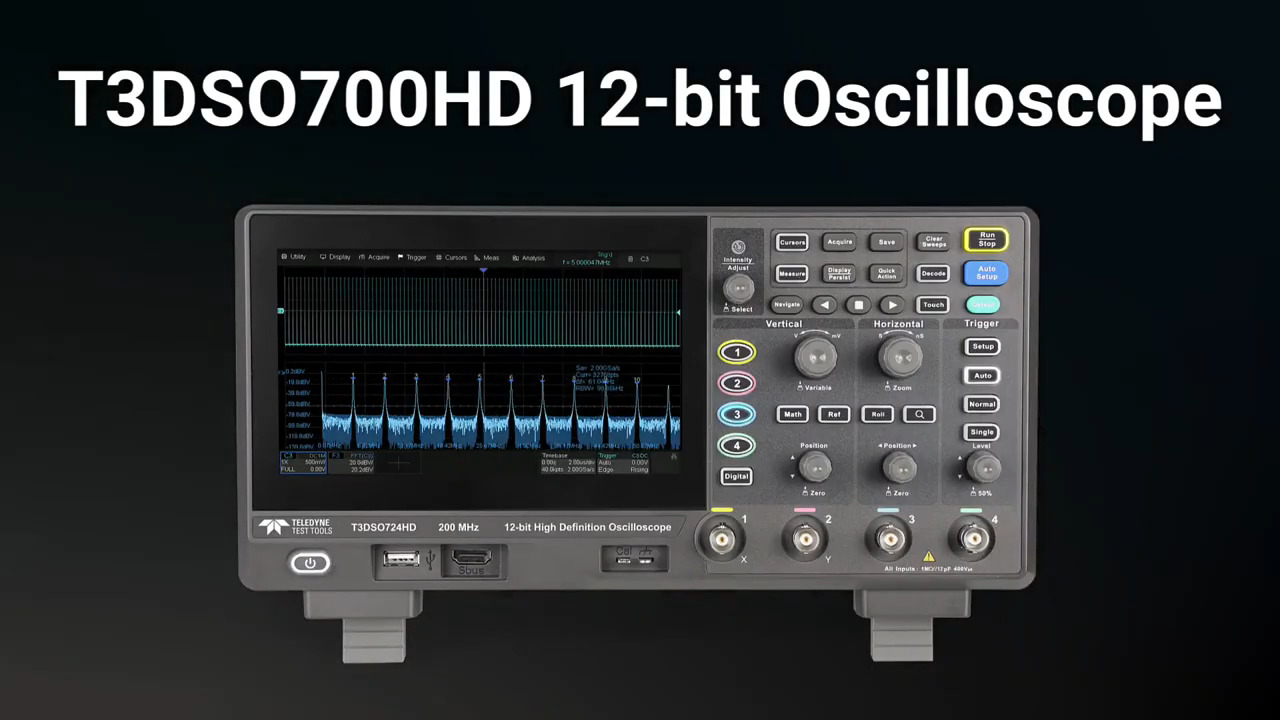
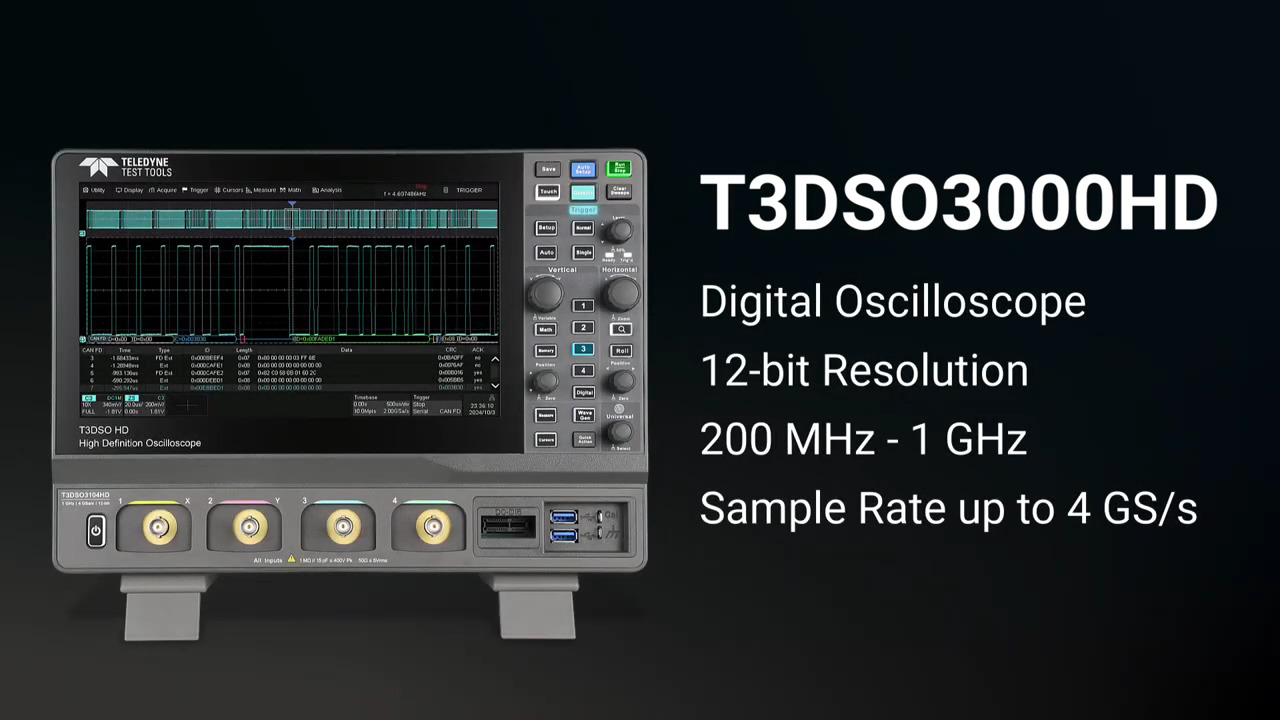
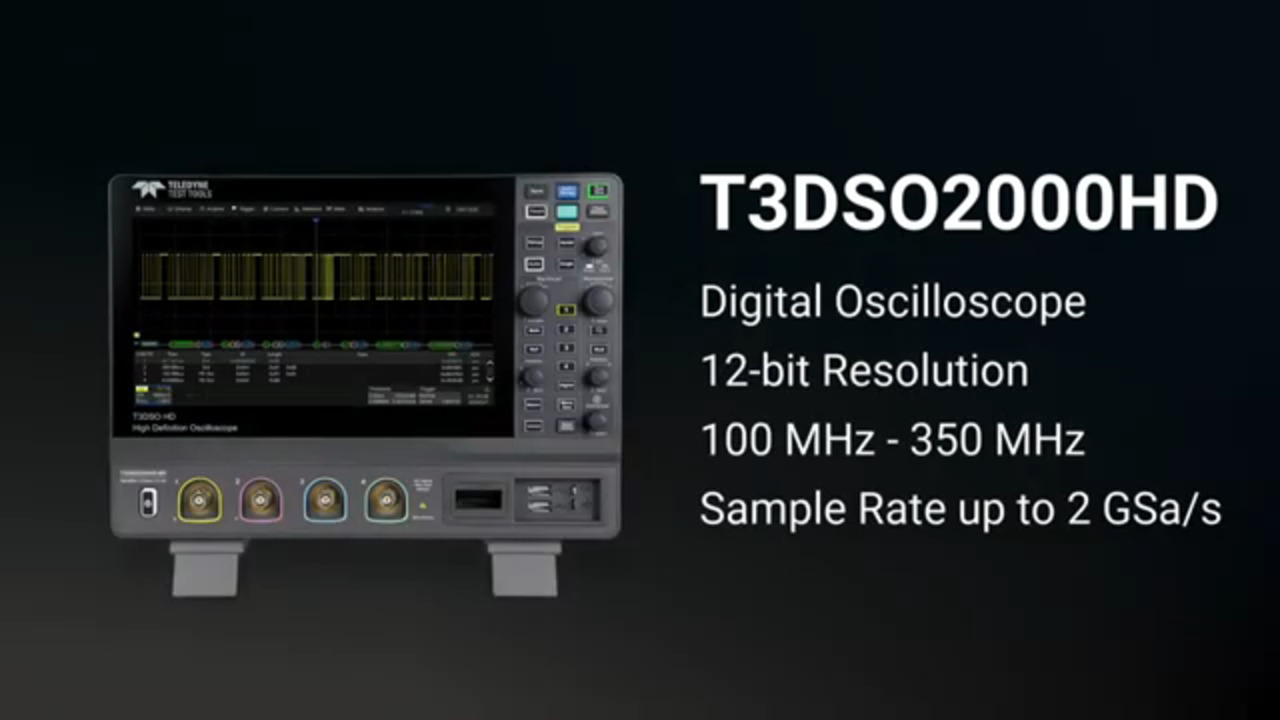
The Teledyne Test Tools include T3DSO700HD, T3DSO1000HD, T3DSO2000HD, and T3DSO3000HD families that bring 12-bit acquisition to more accessible bench configurations, with varying trade-offs in bandwidth, memory depth, capture rate, and built-in analysis capabilities.
WaveSurfer 4000HD is the most accessible platform for engineers who want HD4096 acquisition in a four-channel lab oscilloscope. The family includes the WaveSurfer 4024HD at 200 MHz, 4034HD at 350 MHz, 4054HD at 500 MHz, and 4104HD at 1 GHz.
 Figure 1: Teledyne LeCroy WaveSurfer 4024HD at 200 MHz bench and four analog channels. (Source: Teledyne LeCroy)
All four models provide native 12-bit vertical resolution, an optional 16-channel mixed-signal digital pod, and a 12.1-inch capacitive touch display. The series supports up to 5 GS/s when using two channels and 2.5 GS/s with all four channels active, with standard memory of 12.5 Mpts per channel and up to 25 Mpts in interleaved mode.
HDO4000A occupies the same 200 MHz to 1 GHz bandwidth class but with more features. It adds higher sample-rate capability, more memory options, compact bench depth, large offset capability, mixed-signal variants, zone triggering, and a broader analysis environment.
Other 12-bit platforms from Teledyne LeCroy include the T3DSO700HD and T3DSO1000HD, which can be used for everyday embedded debug, service benches, sensor interfaces, and basic serial communication validation. The T3DSO2000HD and T3DSO3000HD scale the T3 line into higher-performance applications.
The T3DSO3000HD is the most capable T3 HD series platform, with four channels, 12-bit vertical resolution, bandwidth options from 200 MHz to 1 GHz, up to 4 GS/s sample rate in interleaved mode, and up to 400 Mpts of acquisition memory per channel. This long memory makes it useful for long-record captures, intermittent event analysis, and protocol validation.
By moving from 256 to 4096 vertical levels, Teledyne LeCroy’s 12-bit oscilloscope platforms help identify ripple, noise, and transient effects that can be difficult to contrast on an 8-bit instrument. The HD4096-based WaveSurfer 4000HD and HDO4000A families pair this resolution with low-noise acquisition and advanced analysis tools, while the T3DSO HD series extends 12-bit visibility across a range of bench configurations.
For more information, visit Teledyne LeCroy’s 12-bit oscilloscopes.
Disclaimer: The opinions, beliefs, and viewpoints expressed by the various authors and/or forum participants on this website do not necessarily reflect the opinions, beliefs, and viewpoints of DigiKey or official policies of DigiKey.