Settings
 Fast Delivery
 Payment Types


 Marketplace Product

Reducing Downtime in Distributed 24 VDC Control Systems
Contributed By DigiKey's North American Editors
2026-07-16
Modern industrial automation systems increasingly rely on distributed 24 VDC control architectures to power PLCs, remote I/O, sensors, communication hardware, HMIs, and actuators. As machines become more connected and modular, the number of devices operating from a shared 24 VDC power supply continues to grow. These architectures improve flexibility and simplify machine expansion, but they also increase the operational impact of electrical faults occurring on individual branch circuits.
In many systems, a shorted sensor cable, an overloaded actuator, or a failed field device can interrupt power beyond the original fault location. Traditional protection approaches such as fuses and conventional circuit breakers, can disconnect multiple loads before the affected branch circuit is isolated. In systems containing large numbers of connected devices, identifying the failed protection point and restoring operation can become increasingly time-consuming.
Protection architecture also affects control cabinet layout and system scalability. Modern industrial machines continue to add distributed I/O, communication hardware, and auxiliary devices while available panel space remains limited. Branch protection methods requiring multiple individual devices can increase wiring complexity and consume additional DIN rail space.
These combined operational and cabinet-level conditions are driving interest in selective electronic protection systems that isolate the affected branch circuit without impacting the main power supply voltage. While mechanical circuit breakers were previously the standard, newer electronic circuit protection allows designers to isolate faults selectively while reducing the space required for branch protection.
Protection considerations in 24 VDC control systems
In industrial automation, 24 VDC distribution is an ideal voltage from both safety and electrical noise perspectives, as it is considered low-risk enough for technicians to handle during maintenance or troubleshooting, and it produces minimal electromagnetic interference. The widespread adoption of standardized 24 VDC power supplies also simplifies component interoperability across devices from different manufacturers. As these systems support an increasing number of connected PLCs, sensors, actuators, communication equipment, and other field devices, protection devices must manage diverse load profiles, operating characteristics, and fault conditions across branch circuits.
In addition, some industrial devices such as capacitive loads, communication modules, and certain electromechanical devices, may create short inrush events during energization that mimic a fault condition.
Unlike conventional thermal and mechanical protection that may remove power from multiple loads, selective electronic protection continuously monitors current flow across individual branch circuits and electronically disconnects only the affected channel. This ensures unaffected circuits remain energized, allowing machine operation to continue. Because tripping behavior is electronically controlled, protection thresholds and response timing can be matched more closely to different load types, improving fault isolation while reducing nuisance trips.
PISA-M modules in industrial environments
For industrial installations, PULS offers selective protection options with its PISA-M family of multi-channel electronic circuit breakers (Figure 1). The series combines multiple protected channels with a space-saving footprint while providing electronically controlled tripping behavior and channel-level fault visibility, enabling remote configuration, monitoring, and control.
 Figure 1: PULS PISA-M electronic circuit breakers provide selective branch protection for distributed 12 VDC and 24 VDC systems, helping isolate faults without interrupting unaffected circuitry. (Image source: PULS)
PISA-M modules are designed for control cabinets supporting distributed 24 VDC automation systems with multiple protected branch circuits. Typical deployments include packaging machinery, material-handling systems, modular production cells, automated assembly equipment, and process systems containing large numbers of sensors, valves, communication modules, and remote I/O devices.
The modules feature four independently protected channels with integrated electronic fuses for 12 or 24 VDC applications. They are housed in a compact 22.5 mm x 104 mm x 98 mm DIN rail enclosure, allowing them to easily fit within space-constrained control cabinets.
Push-in wiring on the module’s front panel helps reduce installation time and simplify panel assembly compared with conventional terminals. Multi-color LEDs display the status of each output channel in real time, helping maintenance personnel quickly identify affected circuits during troubleshooting. This visibility also simplifies machine restart procedures following fault recovery and helps reduce unplanned downtime during machine service events.
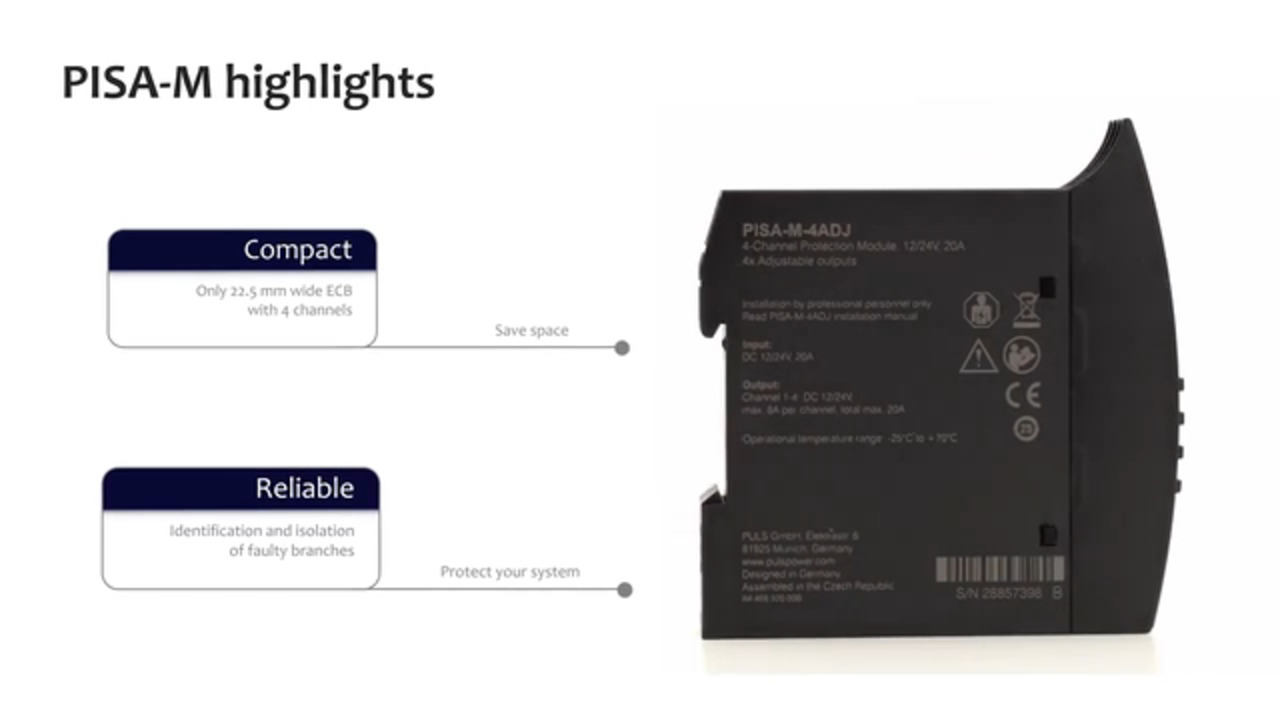
For plug-and-play applications, PULS offers PISA-M versions with output current settings fixed to 2, 4, 6, or 8 A. The PISA-M-4ADJ (Figure 2) is an adjustable version where the tripping current on each output channel can be individually set to 1, 2, 3, 4, 6, or 8 A, with a sum current of 20 A for all channels. This allows protection thresholds to be configured more closely to connected load requirements, helping reduce nuisance trips while maintaining fault isolation. All modules in the series are designed for quick and secure installation, and are configurable without additional tools.
 Figure 2: The PISA-M-4ADJ allows individual channel adjustment to better match protection behavior to mixed electrical loads operating from the same distributed system. (Image source: PULS)
In addition, two PISA-M models allow a single 12 V or 24 V power supply to split its load into four protected NEC Class 2 circuits, the PISA-M-4CL2 (Figure 3) and the PISA-M-402. For automation systems that need to meet compliance requirements, these modules can help reduce the number of power supplies, wiring, and costs. The PISA-M-4CL2 automatically adjusts tripping currents, delivering up to 3.75 A per channel in 24 VDC systems and up to 4.85 A per channel in 12 VDC systems. The PISA-M-402, provides a fixed output of 2 A per channel, making it ideal for protecting sensitive components such as sensors and other low-current devices. Multiple PISA-M modules can be easily connected for installations that need to scale beyond four Class 2 Circuits.
 Figure 3: The PISA-M-4CL2 combines selective electronic protection and NEC Class 2 power distribution within a single compact module for distributed industrial control systems. (Image source: PULS)
Conclusion
As distributed 24 VDC automation systems become more complex, the branch protection architecture plays an increasingly important role in fault isolation performance, control cabinet organization, wiring complexity, and future expansion.
Selective electronic protection solutions such as the PULS PISA-M family improve fault isolation by protecting individual branch circuits, helping to maintain machine availability, reducing downtime and troubleshooting, and enabling scalable control system architectures.

Disclaimer: The opinions, beliefs, and viewpoints expressed by the various authors and/or forum participants on this website do not necessarily reflect the opinions, beliefs, and viewpoints of DigiKey or official policies of DigiKey.