Settings
 Fast Delivery
 Payment Types


 Marketplace Product

Role of Card Edge Connectors in PCIe Gen 6 Systems
2026-01-14
For two decades, the Peripheral Component Interconnect Express (PCIe) standard has supported modern computing infrastructure with scalable bandwidth to connect CPUs to high-speed peripherals, storage controllers, and network interface cards. The exponential growth in AI and HPC workloads has led the industry to transition from the 32 Gigatransfers per second (GT/s) of Gen 5 to the 64 GT/s of Gen 6.
The Gen 5 interconnects are losing usable signal margin faster than anticipated due to the demand for higher lane speeds and wider channels. In response, the PCIe 6.0 specifications have continued the trend of doubling interface bandwidth with each new generation to improve data throughput.
Historically, the PCI Special Interest Group (PCI-SIG) maintained the cadence of bandwidth doubling primarily through frequency scaling and improvements in coding efficiency. From Gen 1 through Gen 5, the interface used Non-Return-to-Zero (NRZ) signaling, a binary modulation scheme in which high and low voltage levels represented 1s and 0s, respectively. This method was simple to implement and offered substantial noise margins.
However, the physics of copper interconnects imposes a frequency wall at which insertion loss and skin-effect degradation become unmanageable. Therefore, to achieve the 64 GT/s target of PCIe Gen 6 without exceeding doubling the baud rate to 64 GBaud, the standard has adopted Pulse Amplitude Modulation with 4 levels (PAM4). The shift has allowed the bus to transmit 64 GT/s while maintaining the same 16 GHz Nyquist frequency as Gen 5.
The move from PCIe Gen 5 to Gen 6 has become more than just an upgrade. It is a discontinuity in the design complexity. The PAM4 reduces the signal eye height to one-third of NRZ signals, degrading the Signal-to-Noise (SNR) ratio by approximately 9.5 dB. The fragility necessitates the implementation of Forward Error Correction (FEC) and a transition to Flow Control Unit (FLIT) encoding.
For system designers, the margin that was previously relied upon in Gen 3 and Gen 4 designs has effectively disappeared. The industry generally targets a channel loss budget of around 32 dB at 16 GHz. This has forced engineers to re-evaluate components in the signal chain. Designers can no longer treat connectors as passive mechanical commodities.
In addition, the risk of delaying this transition to PCIe Gen 6 is significant. As AI accelerators and GPUs continue to scale in power and performance, legacy Gen 5 infrastructure is rapidly becoming the bottleneck. Designing Gen 6 provides the necessary signal integrity and architectural longevity to support the next wave of computing density.
Card edge connectors at Gen 6 speeds
Among all the pieces in the PCIe channel, the card edge connectors that mate an add-in card to a host motherboard are the most important for system performance. The connector serves as a high-speed gateway between a PCIe expansion card and the system board. At Gen 6 speeds, the card edge connectors must maintain controlled impedance across many high-speed signal pairs, introduce minimal insertion loss, and isolate each lane from interference.
Equally important is compliance with the PCIe Gen 6 Card Electromechanical (CEM) standard. The specification describes the mechanical form factor, pinout, and electrical performance requirements for the card edge connector and slot interface.
 Figure 1: Amphenol PCI express Gen 6 CEM card edge connectors support backward compatibility with PCIe 5/4/3/2/1. (Image source: Amphenol)
Amphenol PCIe Gen 6 CEM card edge connectors, for example, were designed to comply with the PCIe 6.0 specifications, including all mechanical and electrical interface standards. The company is among the first to offer a qualified Gen 6 CEM card edge connector solution that meets the demand for 64 GT/s operation.
To facilitate the adoption of the Gen 6 card edge solution, the connector is backward-compatible and footprint-interchangeable with legacy PCIe connectors down to Gen 1. This means they physically drop into the same connector slot on a motherboard and align with the same PCB footprint as Gen 5 or earlier generation connectors.
Measurable performance metrics of Gen 6 card edge
One of the primary challenges at 64 GT/s is maintaining an open eye diagram in the presence of noise. Amphenol achieves this through several design features. The connector housing uses low-halogen, high-temperature thermoplastics with optimized dissipation factor and dielectric constant properties.
To ensure crosstalk isolation, Amphenol has designed the connector to reduce capacitive and inductive coupling between adjacent pairs. This is essential for PAM4, where the reduced noise margin makes the system more sensitive to crosstalk.
The datasheet indicates that the PCIe Gen 6 CEM card edge connector meets the insertion loss and return loss requirements. As a result, the connector consumes only a limited portion of the roughly 32 dB channel loss budget. This is crucial because every decibel saved at the connector is a decibel that can be used for longer PCB traces. The manufacturing tolerance of the contacts also ensures that the impedance remains close to the 85 Ohm target.
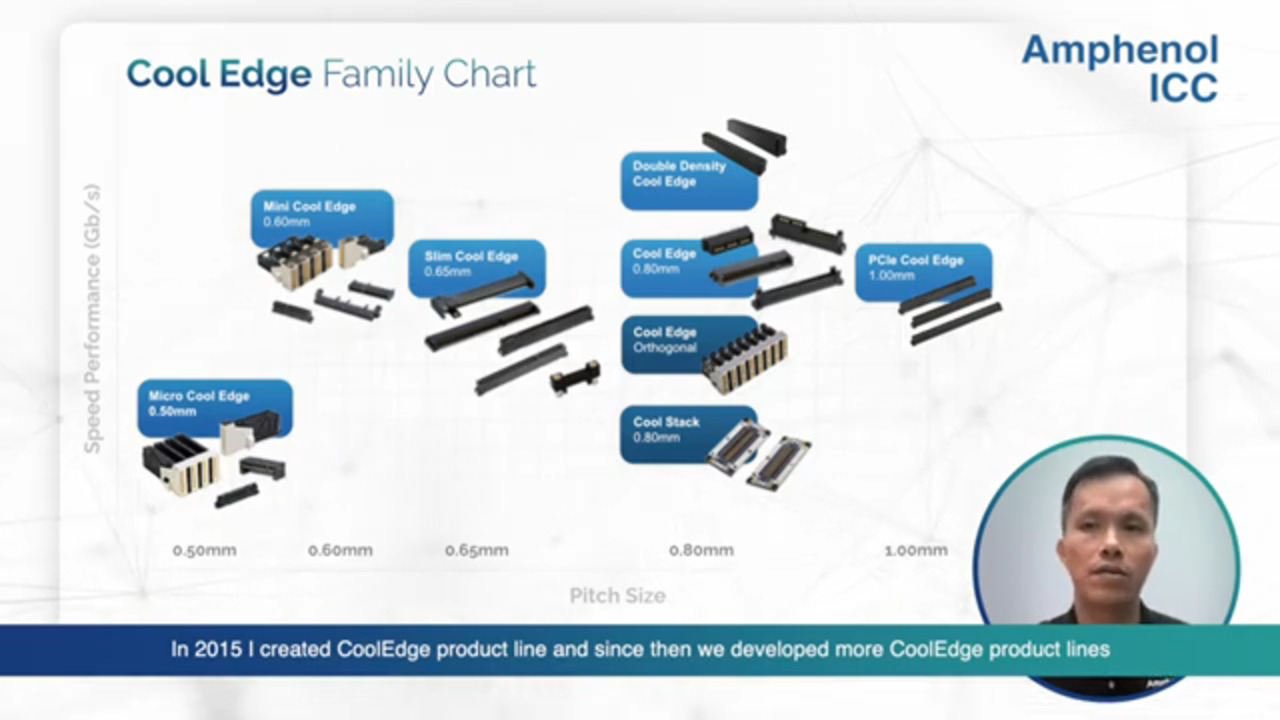
Signal integrity also depends on mechanical parameters. The Amphenol PCIe Gen 6 CEM card edge connector is rated for a minimum of 50 mating cycles, with some variants, like the Mini Cool Edge IO, rated for up to 250 cycles. This durability ensures that the contact plating remains intact, preventing oxidation and increased resistance that could lead to link failures.
The connectors have specific insertion and removal forces to ensure a secure connection that does not disconnect. The integration of side latches or locking mechanisms further secures the add-in card in high-vibration environments.
The Amphenol PCIe Gen 6 CEM card edge connector family provides an early and comprehensive solution for designers targeting the new standard. It offers the necessary high-speed electrical performance while preserving the mechanical interchangeability with existing PCIe slots. The connectors have bridged the gap between theoretical requirements and practical, deployable hardware, a crucial step in the transition to the Gen 6 era.
Conclusion
By adopting these Gen 6 connectors, system designers can ensure that their platforms are not left behind as the PCIe ecosystem evolves.
The move to PCIe Gen 6 is both a challenge and an opportunity. It challenges tightening every aspect of design and revisiting legacy assumptions, but it offers a doubling of performance. With Amphenol PCIe Gen 6 CEM card edge connectors now on the market, designers have the tools they need to build systems ready for the next generation of PCIe.
To learn more, visit the Amphenol PCIe Gen 6 card edge connectors.
Disclaimer: The opinions, beliefs, and viewpoints expressed by the various authors and/or forum participants on this website do not necessarily reflect the opinions, beliefs, and viewpoints of DigiKey or official policies of DigiKey.