Settings
 Fast Delivery
 Payment Types


 Marketplace Product

Ultrasonic Sensors Remain the Go-To Choice for Reliable Proximity Detection
2026-04-17
Proximity sensing is designed to simply determine whether an object is present or not. Determining how far away it is, that’s another story. The real world throws up a wide range of obstacles that make distance measurement more difficult than it might appear. For instance, factory floors tend to fill with airborne dust and welding flash. Warehouse conveyors contain products ranging from matte cardboard to glossy shrink wrap to transparent glass bottles, often on the same line. Outdoor equipment also needs to function exactly the same under direct sunlight as in complete darkness. In all of these conditions, the challenge of a design engineer is to determine which sensor technology will deliver consistent and accurate readings regardless of the target surface and the environment.
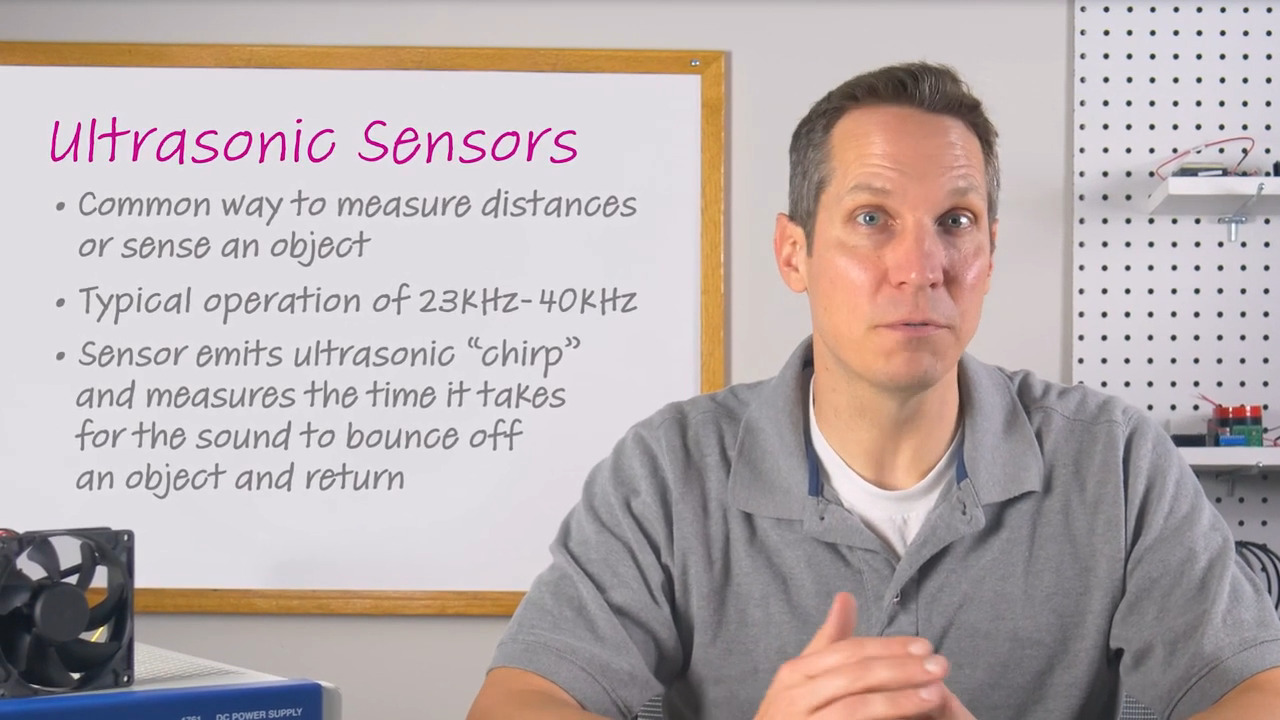
For a wide range of applications, the answer has been ultrasonic sensing, and the technology’s relevance has only grown as autonomous vehicles, industrial robotics, and smart logistics systems have expanded the demand for non-contact detection. The working principle is elegant and simple: a transmitter emits a burst of high-frequency sound (usually between 23 kHz and 40 kHz) that reflects off whatever surface it encounters, and a receiver captures the returning echo. By measuring the round-trip time of flight and applying the speed of sound, the system calculates distance with good accuracy and no physical contact with the target.
Moreover, since the measurement always depends entirely on acoustic energy rather than light or electromagnetic radiation, it remains immune to the visual properties that hamper optical and infrared sensors. A white wall, a black conveyor belt, and a clear acrylic panel all reflect sound waves in essentially the same way, which is exactly the kind of material-agnostic reliability that keeps ultrasonic sensors at the center of so many sensing architectures.
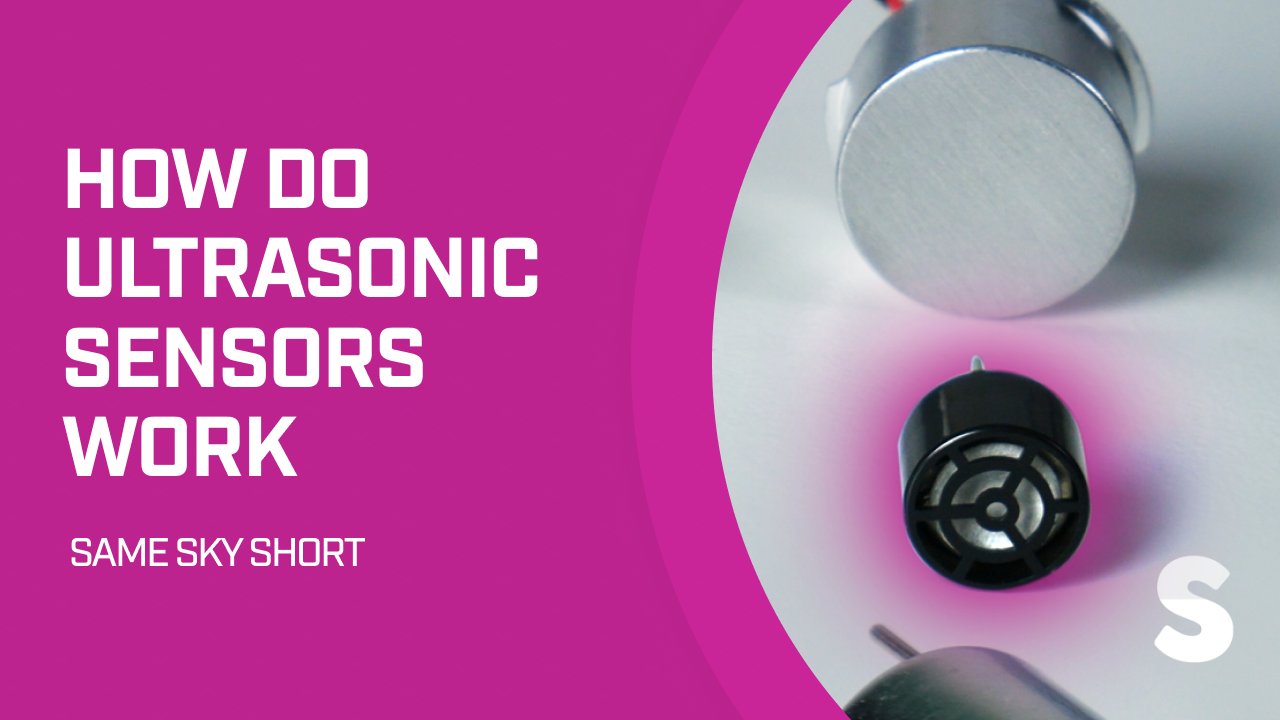
Same Sky (formerly CUI Devices) brings deep expertise in this space with a broad portfolio of ultrasonic transmitters, receivers, and transceivers designed to serve various applications, from industrial automation to rugged outdoor vehicle guidance.
 Figure 1: Same Sky offers a range of ultrasonic transmitters, receivers, and transceivers. (Image source: Same Sky)
How ultrasonic sensing stacks up against the alternatives
While no sensing technology is universally superior, ultrasonic detection occupies a favorable position when the full spectrum of real-world deployment challenges is considered. Photoelectric sensors, for example, work with opaque, consistently colored targets. However, their readings can become unreliable when surface reflectivity varies or the target is transparent, and they can be blinded by direct sunlight or overwhelmed by ambient infrared radiation. Laser rangefinders deliver a very wide range and response speed, but consume far more power, cost more per channel, and have eye-safety compliance considerations that add more complexity and potential regulatory issues. Inductive proximity sensors are excellent for detecting metallic objects at close range, but they are essentially ‘blind’ to plastics, glass, wood, liquids and most other non-ferrous materials, and their effective working distances are measured in millimeters rather than meters.
Ultrasonic sensors sidestep all of these limitations by operating on a principle that utilizes solid and liquid surfaces as a reflector. Their cost per channel remains low, they emit no light (making them effective in total darkness or full daylight), and they can fire hundreds of chirps per second to maintain a high measurement refresh rate, even when tracking fast-moving targets.
Beam behavior and design implications
One characteristic that distinguishes ultrasonic sensing from laser-based measurement is the way an acoustic wavefront behaves as it travels away from the sensor face. Rather than being tightly collimated like a laser beam, the sound pulse spreads outward in a ‘cone-shaped’ pattern, widening its coverage area as the distance increases, much in the same way ripples expand outward when a pebble drops into still water. Sensor makers call this spreading behavior the ‘beam angle’. Same Sky ultrasonic sensors span from a focused 7° up to an expansive 80°.
The choice of beam angle has several implications for system performance. A narrow beam concentrates acoustic energy along a tighter corridor, enabling detection at longer distances and providing more precise positional information about where the target lies within the field of view. On the other hand, a wider beam sacrifices some of that directional precision in exchange for broader area coverage, which is useful in general presence detection, collision avoidance zones, and applications where the target might approach from a range of angles. For design engineers, understanding this tradeoff early in the design process helps them to choose the right sensor configuration without over-engineering or under-specifying the detection geometry.
Same Sky’s ultrasonic sensor portfolio
The wide range of Same Sky’s ultrasonic portfolio gives engineers room to optimize rather than compromise. Transmitters reach detection distances up to 18 meters with operating frequencies from 23 to 40 kHz and beam angles at 60°, 75°, or 80°. They are housed in compact aluminum or plastic cases in through-hole, wire-lead, and wire-lead-with-connector mounting styles. The receivers also offer a wide range of specifications, while the transceivers extend frequency coverage from 25 up to 400 kHz with beam angles from 7° to 80°. In terms of size, package dimensions start as small as 9.8 x 9.8 x 7 mm. Voltage ratings are from 60 to 500 Vp-p across the portfolio, and operating temperatures range from -40 to +85°C depending on the specific model.
For environmental reliability, several Same Sky transceiver models carry IP67 or IP68 ingress protection ratings, meaning sensor housings are sealed against dust ingress and can withstand temporary or continuous immersion in water. For applications in food and beverage processing where washdown cycles are routine, outdoor agricultural equipment exposed to rain, mud, and fertilizer dust, or marine and subsea monitoring, this level of protection eliminates common sources of failure.
 Figure 2: IP-rated ultrasonic transducers for use in harsh environments. (Image source: Same Sky)
Configuration options: paired vs. integrated
Same Sky offers ultrasonic sensors in two main configurations, and the decision between them greatly impacts the design’s cost, footprint, and performance. The first option pairs a dedicated transmitter with a separate receiver, positioned adjacent to each other in the final assembly. This arrangement delivers the smallest achievable blind zone, the minimum distance at which the sensor can produce a valid reading, since the brief ringdown period after the transmitter fires has less overlap with the receiver’s listening window. Separate pairs also offer better sensitivity for detecting faint echoes in acoustically noisy environments. When selecting a matched pair, keeping the rated frequencies of the transmitter and receiver within 1 kHz of each other ensures the best possible signal coupling.
The other option is an integrated transceiver that combines both functions in a single housing. The main benefit here is simplicity and compactness: one component to source, one footprint on the PCB, and one mounting hole in the enclosure. However, the trade-off is a somewhat larger blind zone of roughly 30 cm for standard-frequency models, due to fact that the same element must finish transmitting before it can begin listening for the echo. However, higher-frequency transceivers can narrow this gap to approximately 5 cm, which is more than adequate for most industrial distance measurements where the target sits well beyond the minimum range.
Where ultrasonic sensors are making the biggest impact
Applications for ultrasonic sensing technology cuts across a range of industries and use cases. Manufacturing and warehouse automation systems use ultrasonic arrays along conveyor lines and at pick-and-place stations to detect product presence, verify stacking heights, and trigger diverters regardless of packaging material or color. Mobile robots and autonomous guided vehicles (AGVs) also use ultrasonic sensors arranged in rings or arcs to build real-time obstacle maps, navigate narrow aisles, and stop safely when personnel enter their path. Tank and silo level monitoring also benefits from non-contact ultrasonic measurement since the sensor sits above the media surface, eliminating the risk of contamination and preventing mechanical wear.
In automotive systems, ultrasonic parking sensors have become nearly universal, scanning for nearby obstacles over a wide angular range and operating as effectively at night as in bright conditions. Lastly, in personnel safety applications around heavy machinery, these sensors are helping to detect the presence of humans, while not being fooled by changes in clothing color, high-visibility vests, or ambient light, reducing the likelihood of nuisance trips.
To browse their offering of ultrasonic transmitters, receivers, and transceivers and identify the right sensor for your application, visit Same Sky’s Ultrasonic Sensors product page.
Disclaimer: The opinions, beliefs, and viewpoints expressed by the various authors and/or forum participants on this website do not necessarily reflect the opinions, beliefs, and viewpoints of DigiKey or official policies of DigiKey.