Voltage Divider Calculator
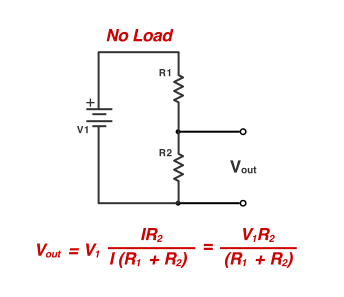
Use this tool to calculate the output voltage of a resistor divider circuit for a given set of resistor values and source voltage.
+More


×
![]()
 Settings
 Fast Delivery
DigiKey customers in the United States can choose from a wide range of fast, reliable delivery options, with shipping rates starting as low as $4.99.
 Payment Types
Credit account for qualified institutions and businesses
Payment in Advance by Wire Transfer


 Marketplace Product
More Products From Fully Authorized Partners
Average Time to Ship 1-3 Days. Please see product page, cart, and checkout for actual ship speed.
Extra Ship Charges May Apply
For more information visit Help & Support
Use this tool to calculate the output voltage of a resistor divider circuit for a given set of resistor values and source voltage.
+More
A voltage divider is a passive linear circuit that produces an output voltage (Vout) that is a fraction of its input voltage (V1). Voltage dividers are used to make signal level adjustments, for active device and amplifier bias, and for measuring voltages.
Ohm's Law explains the relationship between voltage, current, and resistance by stating that the current through a conductor between two points is directly proportional to the potential difference across the two points.
A law is relating the voltage difference between two points, the electric current flowing between them, and the resistance of the path of the current. Mathematically, the law states that V = IR, where V is the voltage difference, I is the current in amperes, and R is the resistance in ohms. For a given voltage, higher resistance entails lower current flow.
-Less

Thank you!
Keep an eye on your inbox for news and updates from DigiKey!
Please enter an email address
Please accept the checkbox