Configuración
 Entrega rápida
 Tipos de pago


 Producto del mercado

Condition Monitoring and Predictive Maintenance in the Age of AI and Industry 4.0
Colaboración de DigiKey
2026-10-29
Condition monitoring and preventive maintenance are two key elements of digitalized production facilities in the spirit of Industry 4.0. But what trends are emerging in this area, how are current solutions structured, how can they be integrated into new and existing plants, and what role do AI and machine learning play?
Three developments are currently shaping the industrial condition monitoring and preventive maintenance market.
First, intelligence is moving to the edge. Sensors and edge devices are increasingly evaluating vibration, temperature, and current signals locally and transmitting only key metrics, condition classes, or alarms instead of raw data. This reduces bandwidth and energy consumption and makes battery-powered wireless sensors with multi-year operating lifetimes practical.
Second, retrofitting machines and plants with condition monitoring and predictive maintenance solutions is becoming easier. Wireless, quick-to-install sensors with preconfigured analytics enable implementation without modifications to machine controls. As a result, secondary assets such as pumps, fans, compressors, and conveyor drives are also coming into focus, although they were previously left unmonitored for cost reasons.
Third, artificial intelligence is gaining ground. The primary focus is anomaly detection based on learned normal operating conditions. In addition, generative AI assistants are emerging that can explain findings in understandable language, search maintenance histories, and formulate recommendations for maintenance personnel.
Data integration and standards are also becoming increasingly important. Condition data should not remain trapped in isolated solutions but should flow into MES, ERP, and maintenance systems, for example via OPC UA and semantically described information models. Finally, the objective is shifting from mere failure prevention toward optimizing energy efficiency, quality, and resource utilization. A drive suffering from early-stage bearing damage or imbalance consumes measurably more energy. Condition monitoring is therefore also becoming a key element of energy and sustainability management.
Adoption status and getting started with the technology
Predictive maintenance appears to have reached small and medium-sized enterprises (SMEs), although not yet on a broad scale. Large companies in sectors such as process industries, power generation, and automotive manufacturing have been operating condition monitoring systems on critical assets for years, often supported by dedicated data teams.
Among SMEs, the picture is more heterogeneous. Many companies have implemented pilot projects on individual machines, but fewer have taken the step toward plant-wide deployment. Considerable work still remains.
The reasons are usually not technical. Companies often lack personnel with data expertise, a robust business case, and a solid data foundation, such as a well-maintained failure history. Moreover, advanced predictive maintenance featuring reliable remaining useful life (RUL) forecasts is technically demanding. Consequently, condition-based maintenance dominates in practice: equipment condition is continuously measured, and deviations trigger inspections or maintenance actions. While less spectacular, it delivers reliable value.
At the same time, the barriers to entry are falling significantly. Affordable wireless sensors, complete solution packages consisting of sensors, gateways, software, and AI-based data analytics, as well as subscription models, make adoption economically feasible even for smaller companies. Machine builders are also increasingly integrating condition monitoring functions directly from the factory and offering them as a service. As a result, SMEs often gain access to the technology indirectly through new machinery rather than through their own dedicated projects.
Overall, SMEs are making progress; however, the key challenge of the coming years will be transitioning from pilot projects to scalable routine operations.
A complete package for quickly entering predictive maintenance is TDK’s edgeRX Starter (Figure 1), available from DigiKey. It enables the detection of potential machine issues up to 14 days in advance, allowing users to take proactive measures before failures occur.
 Figure 1: TDK’s edgeRX Starter solution is a complete package for a quick start in predictive maintenance. (Image source: TDK)
The kit supports straightforward commissioning without external assistance, enabling companies to quickly begin collecting actionable operational data without requiring specialized expertise or extensive system integration. This makes it suitable for initial predictive maintenance projects and for demonstrating value before expanding to other areas of the operation.
edgeRX starter kit includes industrial AI for predictive data analysis, ten LYNQ wireless sensors for machine-level vibration and temperature monitoring, an industrial gateway for secure data collection and transmission, and a license key providing direct access to the edgeRX platform. Together, these components form a seamless connected system capable of detecting early signs of wear and failure based on machine data.
The kit provides actionable insights into machine health and supports the transition from reactive to predictive maintenance. It simplifies access to information and enables faster, more confident operational and maintenance decisions. Integrated analytics identify patterns and indications of failure, enabling earlier intervention, reduced downtime, and extended asset life.
The solution is designed for scalability and can grow from small installations to complex industrial environments. It can initially be implemented on critical assets and later expanded as required, delivering meaningful insights on a reliable and powerful platform for proactive, data-driven maintenance.
How companies should approach implementation
Using edgeRX Starter as an example, it is possible to outline a general approach for industrial companies planning to deploy condition monitoring and preventive maintenance systems.
The starting point should not be technology, but rather the question of which problem needs to be solved. A four-step approach is advisable.
- First: Criticality analysis. Which assets generate the highest costs in the event of failure due to downtime, quality losses, or safety risks? Which failure modes occur most frequently? The answers identify monitoring candidates and suitable process variables.
- Second: A clearly defined pilot project with measurable objectives, such as reducing unplanned downtime, extending maintenance intervals, or lowering spare-parts inventories. The baseline situation must be documented beforehand; otherwise, the future benefits cannot be quantified.
- Third: Process integration. An alarm is only valuable if it is clear who receives it, how it is evaluated, and how it generates a maintenance order. Therefore, integration with maintenance management or ERP systems should be addressed early.
- Fourth: Scaling through a standardized architecture. Companies that equip each machine with a different isolated solution will later struggle with integration. Open interfaces and, where appropriate, a centralized data model pay dividends.
Organizational factors also deserve attention. Maintenance personnel, production teams, OT security, and IT security should be involved from the outset. The practical experience of maintenance technicians is indispensable when evaluating findings. Furthermore, patience is required because data-driven models improve over time as operating data accumulates.
Retrofitting existing plants
Existing plants account for the majority of the installed industrial base, making them a significant source of untapped potential. Retrofitting becomes economically attractive primarily when it can be done without modifying the existing control system.
There are essentially three approaches.
- The simplest involves wireless, battery-powered sensors mounted directly on motors, bearings, or gearboxes. These sensors measure vibration and temperature, partly analyze the data locally, and transmit key indicators wirelessly to a gateway. Cabling is unnecessary, and installation often takes only minutes per measurement point.
- The second approach leverages existing data. Variable frequency drives, motor protection devices, and controllers already provide current, power, and torque information. This data can be extracted through gateways without modifying PLC programs. Motor current signature analysis can thus identify mechanical and electrical faults without installing additional sensors on the asset itself.
- The third option involves edge devices that consolidate signals from multiple sources, preprocess the information, and pass it on to higher-level systems via OPC UA or MQTT.
Implementation should begin with an inventory assessment: Which assets are critical? What data is already available? What network and wireless infrastructure exists? A pilot application should then be performed on a small number of machines with well-understood failure potential.
Equally important are realistic cost calculations, including battery replacement, software licenses, and maintenance effort, as well as early coordination with IT security teams, because every additional networked device represents a potential attack surface.
Types of sensors required
The foundation of condition monitoring consists of vibration, temperature, and pressure sensors because they address the primary causes of industrial equipment failure.
Vibration measurement is the most important diagnostic tool for rotating machinery. Imbalance, misalignment, bearing damage, gearbox wear, and loose connections all leave characteristic patterns in the frequency spectrum.
MEMS accelerometers have significantly transformed this field. They are compact, energy-efficient, and affordable enough for widespread deployment. However, bandwidth and noise performance remain critical for detecting early-stage bearing defects, where piezoelectric sensors continue to offer advantages.
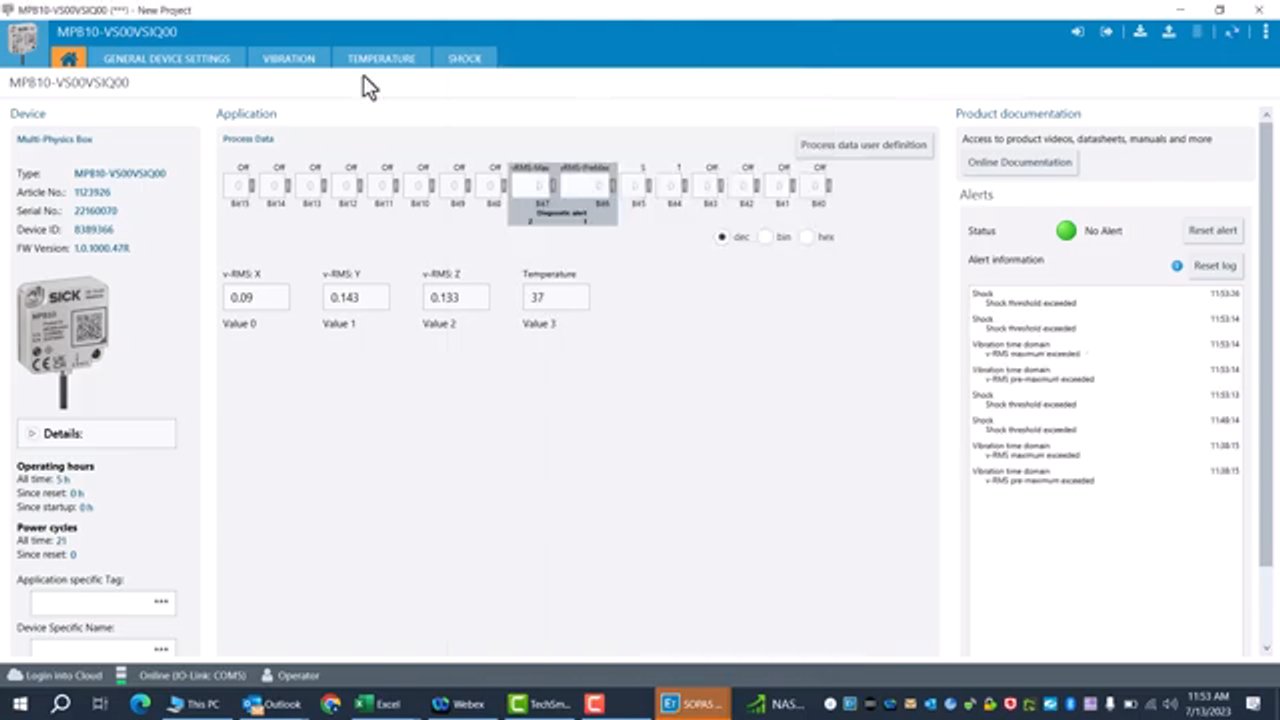
SICK's MPB10-VS00VSIQ00 (Figure 2) condition-monitoring sensor, consisting of a sensor head and M12 connection cable, analyzes and monitors vibration, shock, and temperature. Its core technology is a capacitive MEMS sensing element. Measured data is transmitted via IO-Link, and its housing complies with IP68 protection requirements.
 Figure 2: The MPB10-VS00VSIQ00 condition monitoring sensor from SICK AG analyzes and monitors vibrations, shocks, and temperature. (Image source: SICK AG)
Temperature sensors are simple and robust. They can indicate friction, lubrication deficiencies, overloads, and electrical problems. Their strength lies in complementing other measurements and validating diagnostic results.
For continuous thermal monitoring of critical components such as high-voltage switchgear, transformers, hydraulic systems, data centers, bearings, and gearboxes, Omron’s K6PM Thermal Condition Monitoring Device (Figure 3) is suitable. It combines a controller with an integrated display and a remotely operated thermal imaging camera. The system eliminates the need for manual thermal inspections and allows remote real-time monitoring of critical components.
 Figure 3: Omron’s K6PM thermal condition monitor uses a controller with a built-in display and a remote-controlled thermal imaging camera. (Image source: Omron)
Pressure sensors are particularly important in hydraulics, pneumatics, and process industries. Pressure trends reveal leaks, clogged filters, pump cavitation, and valve wear.
The robust PQS812 pressure monitoring device (Figure 4) from ifm Efector enables reliable monitoring of system pressure in pneumatic and compressed-air systems. It offers high overpressure and vacuum resistance, an easy-to-read TFT display, programmable switching outputs, and seamless integration into various control systems through local buttons and IO-Link parameterization.
 Figure 4: The PQS812 pressure monitor from ifm Efector enables system pressure monitoring in pneumatic and compressed air systems. (Image source: ifm Efector)
All these sensor systems exemplify the trend toward signal processing directly within the sensor itself.
Additional value is generated through sensor fusion. Combining multiple measured variables with operational data such as speed, load, and current consumption enables more reliable diagnostics while reducing false alarms.
Other increasingly important methods include structure-borne sound and ultrasound measurement for early bearing fault detection, motor current analysis, and oil condition monitoring.
The importance of edge and cloud computing
In digitalized industry, a dual architecture combining edge and cloud computing has become established.
Edge and cloud are not competitors; they complement one another. The key lies in allocating tasks appropriately.
Smart sensors perform the first stage. They filter signals, calculate indicators such as RMS values, peak values, or envelope spectra, and detect threshold violations. Modern microcontrollers with DSP capabilities and AI accelerators can even execute simple anomaly detection models directly within the sensor.
This significantly reduces data transmission requirements, lowering energy consumption and extending battery life in wireless sensor networks.
Edge devices and gateways form the second layer. They aggregate data from multiple sensors, translate protocols, execute more sophisticated analytics, and respond with low latency. Sensitive production data remains onsite, and monitoring continues even if internet connectivity is interrupted.
The cloud, or a central data center, excels where computing power and large datasets are required, including model training, long-term analytics, cross-site fleet comparisons, and integration with enterprise systems.
A useful rule of thumb is:
- Decisions requiring speed, frequency, and locality belong at the edge.
- Tasks requiring extensive historical data, large numbers of assets, or substantial computing resources belong in the cloud.
Models are often trained centrally and subsequently distributed to edge controllers. Companies must also address data ownership, communication and storage costs, and lifecycle management of software and AI models.
Serving as a bridge between edge and cloud is the AXC F 1252 PLCnext Control PLC (Figure 5) from Phoenix Contact, available through DigiKey. When production data needs to be forwarded to analytics platforms, enterprise systems, or cloud services, the controller connects OT (operational technology) and IT (information technology) environments through a single platform.
 Figure 5: The AXC F 1252 PLCnext Control from Phoenix Contact connects OT and IT systems via a single controller. (Image source: Phoenix Contact)
It runs a real-time Linux operating system for deterministic execution of time-critical processes while supporting both IEC 61131-3 PLC programming and high-level languages such as C++, C#, and Python.
At its core is a dual-core Arm® Cortex®-A55 processor operating at 1.7 GHz, providing ample performance for edge-computing applications. The controller integrates into existing industrial networks using Profinet, Modbus TCP/RTU, and EtherNet/IP, while simultaneously communicating with IT systems via OPC UA, HTTPS, SQL, Proficloud, and other cloud platforms.
AI and machine learning in condition monitoring (CM) and predictive maintenance (PM)
The most important AI application in condition monitoring and predictive maintenance is anomaly detection.
This approach learns normal machine behavior from operational data and reports deviations. Its key advantage is that it does not require failure data, which is often scarce in well-maintained facilities.
Methods range from statistical techniques and clustering algorithms to autoencoders.
For fault classification, such as distinguishing between imbalance, misalignment, and bearing damage, supervised learning methods are used. However, these require labeled examples. Combining them with physical knowledge, such as known bearing fault frequencies, or simulation data can significantly improve performance.
Remaining useful life prediction is arguably the most challenging discipline. It works well where wear progresses continuously and measurably and where sufficient historical data exists, such as in tools, filters, or certain bearings. It is less reliable for sporadic or sudden failures.
Challenges also arise under changing operating conditions. When products, rotational speeds, or loads vary, models must account for these changes; otherwise, false alarm rates increase. Moreover, a model trained on one machine cannot necessarily be transferred directly to an identical machine operating in a different environment.
Transparency is crucial for user acceptance. Maintenance personnel are more likely to trust alarms if the system can explain which variables changed and how. Successful solutions therefore combine domain expertise with AI rather than attempting to replace human expertise entirely.
Opportunities and limitations of AI
AI offers three major capabilities that traditional threshold monitoring cannot easily achieve.
- First, it recognizes patterns in multidimensional datasets. No human can simultaneously track dozens of variables over months. AI can identify subtle relationships, such as a slightly rising temperature that indicates damage only when occurring under specific loads and alongside changes in the vibration spectrum.
This enables earlier fault detection with fewer false alarms than fixed thresholds.
- Second, AI scales expert knowledge. AI-supported systems can pre-evaluate hundreds of measurement points and involve specialists only when actual anomalies require attention.
- Third, AI simplifies access to insights. Generative AI and language models introduce a new level of usability by explaining findings in plain language, searching maintenance manuals and fault histories, finding similar historical cases, and recommending actions. This makes knowledge accessible even to less experienced employees.
However, expectations must remain realistic. AI is only as good as the data it receives. Incorrectly installed sensors, incomplete time series, or missing operational context lead to inaccurate results.
AI does not replace human decision-making; it supports it. The greatest value is achieved when AI is combined with physical understanding of machines and the practical experience of maintenance professionals.
Communication technologies and standards for CM and PM
The Industrial Internet of Things incorporates numerous communication technologies, including Ethernet, increasingly in the form of Single Pair Ethernet, OPC UA, IO-Link, Bluetooth Low Energy, Wi-Fi, and private 5G networks.
Each technology has its place in IIoT, condition monitoring, and predictive maintenance.
IO-Link is well established at the field level. The point-to-point connection provides process values, diagnostics, and condition data while enabling remote parameterization. IO-Link Wireless extends these capabilities to moving or difficult-to-access components.
Single Pair Ethernet brings Ethernet connectivity directly to sensors using a two-wire cable for both data and power. In particular, 10BASE-T1L, with ranges of up to 1,000 meters, is highly attractive for process industries and, through Ethernet-APL, can also be used in hazardous environments.
OPC UA serves as the central integration layer. Through Companion Specifications, such as OPC UA for Machinery, it provides not only data but also semantic descriptions. Combined with MQTT, it is well suited for cloud integration.
Wi-Fi is widely available and offers high bandwidth but consumes considerable energy and is not always deterministic in industrial environments.
Private 5G networks deliver high reliability, low latency, and support for large device densities. They are most beneficial when campus-wide connectivity is already being established for multiple applications.
Bluetooth Low Energy (BLE) is playing an increasingly important role in retrofit projects. Extremely low power consumption enables battery-powered sensors with multi-year lifetimes. BLE is best suited for transmitting processed metrics rather than raw data streams and is therefore ideal for sensors with onboard preprocessing.
Gateways and mesh networks can cover large industrial halls, while BLE also facilitates commissioning and service via smartphones.
Its limitations include range, data rates, and susceptibility to interference in metal-rich environments. For large geographic areas, LPWAN technologies such as LoRaWAN, NB-IoT, and mioty can be attractive alternatives.
Cybersecurity and regulatory considerations
The convergence of IT and OT into the IIoT creates cybersecurity challenges that directly affect condition monitoring and predictive maintenance systems.
Such systems expand the attack surface because every connected sensor, gateway, and cloud connection represents a potential entry point.
Typical risks include unencrypted wireless communications, weak passwords, outdated firmware, and gateways that unintentionally bridge the internet, corporate IT systems, and production networks. Attackers could intercept data, manipulate measurements to trigger incorrect maintenance decisions, or use monitoring infrastructure as a pathway into operational technology networks.
The Cyber Resilience Act (CRA) fundamentally changes requirements for manufacturers. Products with digital elements, including smart sensors, gateways, and associated software, must implement security by design, manage vulnerabilities throughout the support period, and provide security updates.
Since September 2026, incident-reporting obligations for actively exploited vulnerabilities apply, and the regulations become fully applicable in December 2027. Secure boot processes, encrypted communications, software bills of materials (SBOMs), and secure update mechanisms thus become mandatory.
NIS2 targets operators. Companies in covered sectors, including large portions of manufacturing, must establish information security risk management processes, report incidents, and consider supply chain security. Monitoring systems are included within this scope.
Adherence to the IEC 62443 standards series is highly recommended. Network segmentation, access control, encrypted communication, and rigorous patch management are key measures.
When selecting solutions, security features and manufacturer commitments regarding updates should become important purchasing criteria.
DigiKey as a distributor of automation components
All products and systems mentioned are available through the distributor DigiKey. The company is increasingly active in the automation sector, and its portfolio allows complete condition monitoring and predictive maintenance solutions to be assembled.

Descargo de responsabilidad: Las opiniones, creencias y puntos de vista expresados por los autores o participantes del foro de este sitio web no reflejan necesariamente las opiniones, las creencias y los puntos de vista de DigiKey o de las políticas oficiales de DigiKey.