Configuración
 Entrega rápida
 Tipos de pago


 Producto del mercado

Ultra-Low-Power and High Performance: Nordic’s nRF54L15 Redefines Wireless IoT Design
2025-12-31
Battery life remains the persistent challenge in wireless IoT product development. Devices often need to run for months or years on coin cells while handling increasingly complex protocols and security requirements. Nordic Semiconductor’s nRF54L15 Series SoCs meet these needs with a combination of advanced process technology, architectural efficiency, and flexible memory configurations that allow designers to balance performance and power budgets in ways previous generations couldn’t support.
The nRF54L15 is Nordic Semiconductor’s transition to a 22nm process node, moving from the established nRF52 Series architecture that has defined Bluetooth Low Energy implementations across consumer and industrial markets. This shift delivers measurable improvements: power consumption drops 30 to 50% in common Bluetooth LE use cases compared to the nRF52 Series, while processing capability increases substantially. The device achieves 503 CoreMark with an efficiency rating of 193 CoreMark/milliampere at 3.0 V, providing triple the processing efficiency of its predecessor while operating from the same battery chemistry.
Dual-core processing architecture
 Figure 1: Nordic’s nRF54L15 ultra-low-power wireless SoC in a QFN package. (Image source: Nordic)
Under its hood, the nRF54L15 integrates a 128 MHz Arm® Cortex®-M33 processor with TrustZone security extensions and a 128 MHz RISC-V co-processor. This dual-processor arrangement serves specific design purposes rather than just general parallelism. The RISC-V core handles time-critical wireless protocol operations, implements custom protocol stacks, and enables what Nordic terms soft peripherals; software-defined peripheral functions accelerated with hardware support. For product designs that might otherwise require a separate microcontroller to handle sensor interfaces or custom communication protocols, the RISC-V coprocessor absorbs those functions within the wireless SoC.
Memory configurations scale across three pin-compatible variants. The nRF54L15 provides 1.5 MB of RRAM non-volatile memory and 256 KB RAM. The nRF54L10 reduces these to 1.0 MB NVM and 192 KB RAM, while the nRF54L05 offers 0.5 MB NVM and 96 KB RAM. All three variants share identical footprints in QFN packages, which means that designers can develop a single PCB layout and select memory configurations based on application requirements and cost targets.
Multiprotocol radio capabilities
The nRF54L15 features a 2.4 GHz radio that provides configurable transmit power ranging from -10 dBm to a maximum of +8 dBm (CSP package) or +7 dBm (QFN package), adjustable in 1 dBm increments. This granular control allows designers to balance transmission range against current consumption based on specific application requirements. Receive sensitivity is from -96 dBm at 1 Mbps BLE data rates, while the IEEE 802.15.4 reception reaches -102 dBm sensitivity. This radio supports multiple wireless protocols within the 2.4 GHz band.
Bluetooth Low Energy (BLE) modes for the nRF54L15 include LE Coded PHY for longer range, LE 1M for standard operation, and LE 2M for higher throughput. Channel Sounding capability, introduced in Bluetooth Core 6.0, also enables centimeter-level distance measurement between devices. Moreover, IEEE 802.15.4-2020 support at 250 kbps provides the foundation for Thread, Zigbee, and Matter protocol applications. Proprietary 2.4 GHz GFSK modulation operates at 1 Mbps, 2 Mbps, or 4 Mbps for a broad range of applications that require custom protocols with specific latency or throughput features. The nRF54L15 also utilizes a NFC-A listening device for near-field communication, supporting tap-to-pair functionality or proximity-based configurations.
Power consumption
Nordic understood that battery life constraints affect every wireless IoT design decision, and the nRF54L15’s power characteristics reflect this reality. During radio reception, the device draws 3.4 mA at 3.0 V supply voltage, which is half what the nRF52840 consumes when operating from a 1.8 V supply. Also, transmit current at 0 dBm output power is 4.8 mA. These improvements matter because most wireless devices spend the majority of their operational life receiving rather than transmitting, which makes receive current the dominant factor in battery longevity calculations.
When not actively communicating, sleep mode currents range from 0.7 µA to 2.9 µA, depending on which peripherals remain powered and how much RAM retains its contents. The Global RTC peripheral continues to operate in system OFF mode while drawing just 0.8 µA, which eliminates the need for external real-time clock components that would otherwise occupy board space, add to bills of materials, and consume their own supply current. For products typically spending months in storage or containers before activation, hibernation mode lowers consumption below 50 nanoamperes, allowing shelf life to be measured in years rather than months.
Security architecture
Connected devices operate in hostile environments where physical access and network-based attacks can pose real threats to users’ data and device integrity. Nordic designed the nRF54L15 to meet PSA certified level 3, the highest security certification level for IoT devices that protects against both software and hardware attack vectors.
Security starts with Arm TrustZone isolation, which partitions the system into secure/non-secure domains at the hardware level. Critical operations like cryptographic key storage/authentication run in the secure domain where even compromised application code cannot access them. The cryptographic accelerator also handles encryption operations and protects against side-channel attacks that might attempt to extract keys by analyzing timing variations or power consumption patterns during cryptographic operations.
Secure boot uses an immutable boot partition that cannot be modified after manufacturing. Two independent watchdog timers monitor secure and non-secure domains separately, preventing one domain from disabling protection in the other.
Peripheral complement and package options
GPIO count is from 31 to 35 depending on package selection, organized across three ports with different speed capabilities. Port 2 supports 64 MHz high-speed operation while Ports 0 and 1 operate at 8 MHz. The nRF54L15’s serial interfaces include four configurable SPI/TWI/UART peripherals plus an additional high-speed SPI/UART combination. A 14-bit ADC (upgraded from 12-bit resolution on the nRF52840) provides eight channels with resolution that trades against sample rate: 14-bits at 31.25 ksps oversampled, 12-bits at 250 ksps, or 10-bits up to 2 Msps. Other peripherals include an I2S audio interface, PDM for digital microphones, PWM, a quadrature decoder, comparators, and a temperature sensor.
Nordic offers the nRF54L15 in two package formats for different design priorities. The QFN 6x6 mm 48-pin package has 31 GPIO and full peripheral access in a conventional surface-mount format. The WLCSP 2.4 x 2.2 mm chip-scale package is ideal for compact product designs like smart rings and wearables. The operating temperature is from -40°C to +105°C and the supply voltage ranges from 1.7 V to 3.6 V.
Development resources and use cases
 Figure 2: Nordic’s nRF54L15 ultra-low-power wireless SoC in a WLCSP package. (Image source: Nordic)
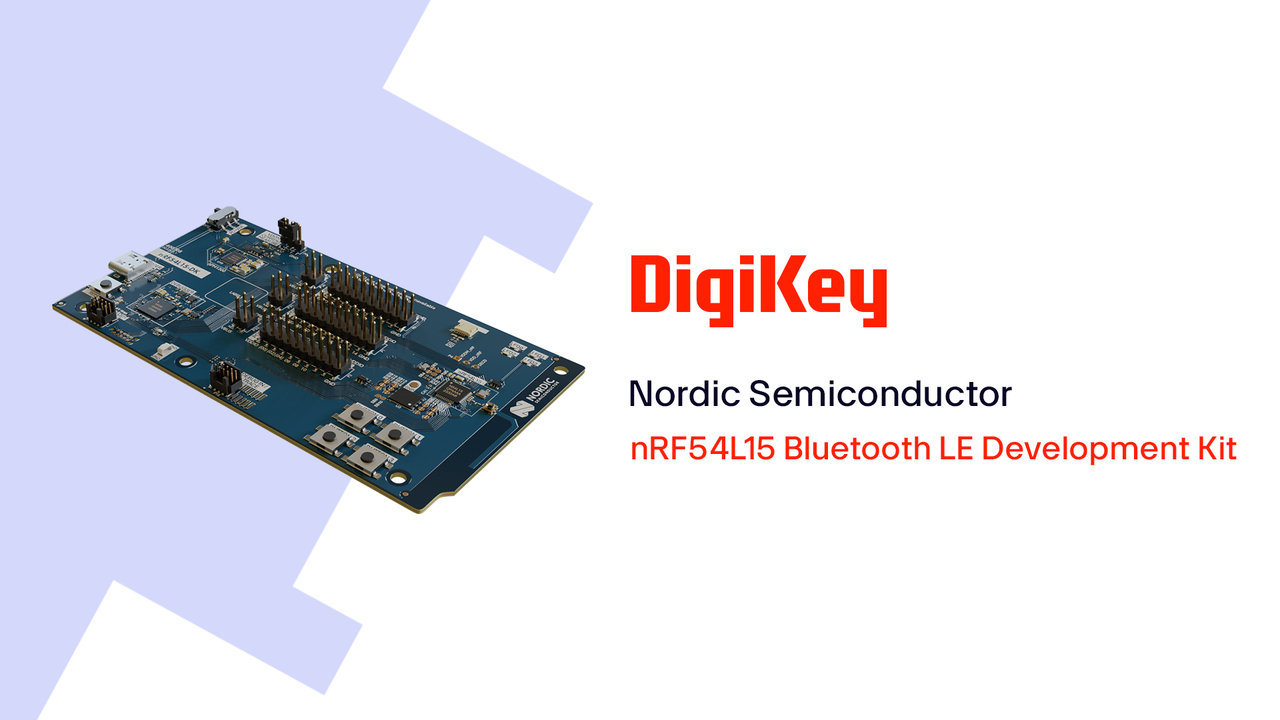
The nRF54L15-DK development kit provides the QFN48-packaged SoC, 64 Mb external Flash, an onboard SEGGER J-Link debugger, four user LEDs and buttons, an NFC antenna, and power measurement capabilities. The kit can emulate the nRF54L10 and nRF54L05 models, allowing developers to try out other budget-friendly memory configurations without purchasing additional hardware. Software development uses the nRF Connect SDK built on Zephyr RTOS. Nordic also offers a bare-metal development option independent of Zephyr for simpler BLE applications that don’t require a full RTOS.
Nordic focuses on medical devices, smart home solutions, industrial IoT, VR/AR accessories, PC peripherals, gaming controllers, wearables, smart rings, electronic shelf labels, asset trackers, and beacons as key applications.
For more information, please visit nRF54L15 Development Kit
Descargo de responsabilidad: Las opiniones, creencias y puntos de vista expresados por los autores o participantes del foro de este sitio web no reflejan necesariamente las opiniones, las creencias y los puntos de vista de DigiKey o de las políticas oficiales de DigiKey.