Configuración
 Entrega rápida
 Tipos de pago


 Producto del mercado

Position Feedback Without Trade-Offs Using Same Sky’s Capacitive Encoders
2026-10-01
Encoders rarely fail completely; instead, they degrade gradually, which closed-loop controllers cannot detect. The servo loop accepts miscounted edges and drifting position data as accurate and acts on them with full confidence, driving the axis to the wrong place but reporting a correct arrival. This is why the choice of encoder sensing technology matters more than the headline resolution figure, as two of the three technologies commonly used today degrade in this way. Optical encoders resolve fine increments but depend on an unobstructed light path, which dust, grease, and condensation progressively obscure. While magnetic encoders survive such contaminants, they sit inside the stray magnetic fields generated by the motors they monitor.
Same Sky’s (formerly CUI Devices) AMT series encoders work using capacitive sensing, which is not susceptible to contaminants, and is as rugged as magnetic sensing with higher accuracy and resolution. Unlike the other two options, this technology supports field-programmable resolution.
How capacitive sensing works
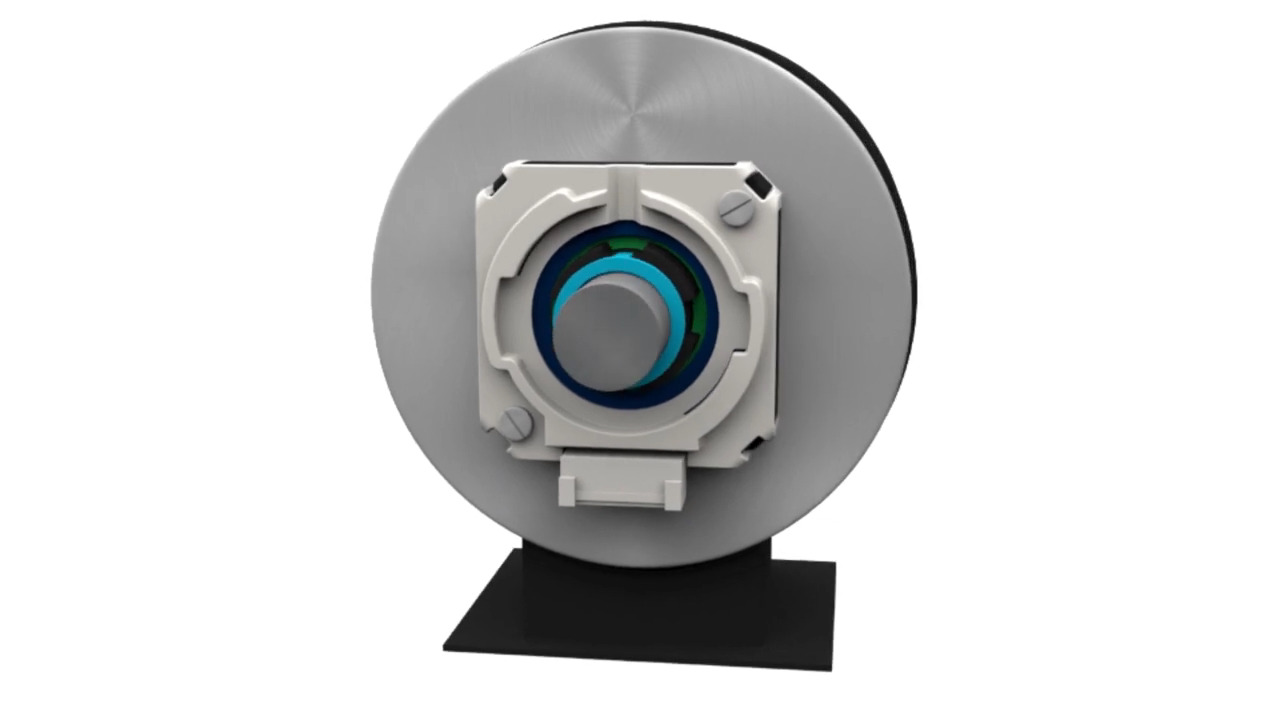
An AMT encoder has three parts: a stationary transmitter, a rotor carrying a sinusoidal metal pattern, and a stationary receiver. The transmitter emits a high-frequency AC field, and as the rotor turns, its metal pattern varies the capacitive reactance between the transmitter and the receiver, modulating the field in step with the shaft position. A proprietary ASIC in the receiver demodulates the signal and converts it into output pulses that are compatible with the same circuitry that an optical encoder utilizes.
There are two main advantages with this architecture. First, nothing in the signal path depends on an optical window, so contamination that can blind a photodetector has no equivalent effect, and the design tolerates submersion in non-conductive fluids, such as gear oil. Second, position is derived from an electric field rather than a magnetic one, so mounting the encoder directly on a motor does not compromise its readings.
Note that the fluid tolerance is a property of the sensing method, not a sealing specification. AMT encoders carry no formal IP rating, so wet or wash-down environments must be verified against your specific mounting.
Resolution you can change after the design is fixed
The typical design process requires committing to an encoder resolution before characterizing the control loop that relies on it. Capacitive sensing removes this commitment because its resolution depends on how the ASIC interprets the modulated field data, rather than on a fixed value.
The AMT incremental kits make the resolution user-adjustable across 16 to 22 selectable values depending on the series, from 48 PPR up to 4,096 PPR on the AMT11 and AMT13, and 5,120 PPR on the AMT10E. The AMT10 is set with a DIP switch, while the AMT11, AMT13, and other series are software-configurable.
The ability to change the resolution after mounting the encoder gives you greater flexibility during development. You can run the prototype at a coarse resolution while mechanical revisions are still underway, then increase the resolution once the control loop bandwidth is established and the actual feedback requirements are known. To support this workflow, Same Sky offers both configurable and preconfigured encoders. The configurable “-V” kits offer multiple sleeve bores, mounting orientations, and interface options, allowing a single AMT10-V to support up to 288 configurations from a single part number. Once the orientation, resolution, and bore diameter have been finalized, preconfigured models provide a fixed part number for production.
Whichever encoder format is selected, it can be configured using Same Sky’s AMT Viewpoint GUI. This free Windows application connects to the encoder through an AMT-PGRM module and sets the resolution, direction, pole count and zero position. It also plots the output waveforms, allowing for quick data analysis.
Choosing between incremental, absolute, and commutation feedback
Once the resolution has been determined, the next criterion is the type of feedback required. The main consideration is whether the control system needs to know the shaft position the instant power is applied or whether it can find a reference position through a homing sequence. Which AMT family is the best fit for an application will depend upon this requirement. Figure 1 illustrates several industrial applications that rely on encoder feedback for precision movement and position control.
 Figure 1: Encoders can be used in a wide variety of industrial applications to provide precision movement and essential feedback (Image source: Same Sky)
Incremental encoders provide relative position information rather than angular position, making them well suited to systems that can execute a homing routine to find a known reference point. Because position is derived by counting quadrature pulses, the controller can track motion without the overhead of polling a serial bus.
Examples of incremental encoders are the AMT10 and AMT10E series (Figure 2) that come in a 28 mm body, running 48 to 2,048 PPR and up to 5,120 PPR respectively, with A/B quadrature outputs and an index pulse in single-ended or differential line driver output. For smaller motors, the AMT12 series comes in a 22 mm body for use with 1 to 6 mm shafts, small enough to mount on a NEMA 08 frame.
 Figure 2: The AMT10 and AMT10E incremental encoders. (Image source: Same Sky)
Homing is not always a practical option, especially in systems that must know their position immediately after power-up. In these applications, an absolute encoder eliminates startup uncertainty by reporting a shaft’s exact position as soon as power is applied. Same Sky offers 12-bit and 14-bit resolution options, providing 4,096 or 16,384 distinct positions per revolution, respectively. For axes that can rotate many times between limits, such as geared drives, rotary tables, or lead-screw actuators, multi-turn versions track the total number of revolutions in addition to angular position. With a multi-turn count range of -8,192 to +8,191 revolutions, the encoder retains position information across power cycles, allowing the system to resume operation without a homing sequence.
Once absolute feedback has been selected, the next consideration is the communication interface based on factors such as cable length, electrical noise, and the number of encodes in the system. For short, point-to-point connections between the encoder and a controller, the AMT20 and AMT22 use Serial Peripheral Interface (SPI), a simple and efficient protocol suitable for direct communication. Applications requiring longer cable runs or operation in electrically noisy environments are better served by the AMT21 and AMT24, which use the differential RS-485 interface. In addition, RS-485 allows up to 64 encoders to share a single bus. For systems that require a Synchronous Serial Interface (SSI), the AMT23 provides a single-ended SSI output option.
While incremental and absolute encoders are selected primarily based on how position information is acquired and communicated, some applications require an additional type of feedback. Brushless DC (BLDC) motors, for example, need commutation information in conjunction with shaft position so the controller can energize the correct motor phases. For these applications, the AMT31 and AMT33 provide both functions, generating U, V, and W commutation signals together with incremental A, B, and Z outputs, and supporting 2 to 20 poles. Aligning a commutation encoder to a motor’s electrical phase normally involves measuring back-EMF on an oscilloscope, but Same Sky’s AMT One Touch Zero™ Alignment Tool, the AMT-OTZ-1, replaces that with a button press, which saves about 20 minutes per motor build.
Why supply current matters on battery power
It is usually possible to ignore encoder supply current on mains-connected equipment, but on battery-powered platforms it becomes a more significant design consideration. Encoders draw current continuously whenever they are energized, including periods when a motor remains stationary. Because encoder technologies differ substantially in their operating current requirements, the choice of sensing technology can have a measurable impact on overall system power consumption and battery life.
Same Sky’s AMT series capacitive encoders are designed with low power consumption in mind. The AMT10 and AMT10E models draw just 6 mA at 5 V, while their remaining incremental, absolute, and commutation encoder families draw only 16 mA. In Same Sky's four-axis comparison, four AMT10 encoders consumed a total of 0.12 W, while four optical encoders drawing 85 mA each consumed approximately 1.7 W, and four magnetic encoders operating at 160 mA each consumed about 3.2 W.
One and a half to three watts may appear small when compared with motor power, but encoder power draw is continuous and accumulates over the entire operating cycle. In battery-powered equipment, reducing this constant load can help extend operating time, improve energy efficiency, and ease battery-capacity requirements.
Mounting and retrofit considerations
Every option above must attach to a motor shaft. AMT kits accommodate shafts from 1 mm to 15.875 mm (5/8 in.), typically through nine sleeve bore options per kit, with a locking hub that reduces mounting and alignment time to seconds. This flexibility is especially valuable in retrofit applications, where a machine already in service gains encoder feedback or transitions to capacitive sensing without requiring changes to the motor mount or surrounding structure, as the kit adapts to the existing shaft.
Conclusion
Same Sky’s AMT capacitive encoders combine contamination tolerance, magnetic immunity, field-programmable resolution, and low power consumption in a flexible platform. With incremental, absolute, and commutation options, the AMT series gives designers a practical way to match position feedback to the needs of robotics, mobile equipment, and industrial automation.
For more information on Same Sky’s AMT series encoders, please visit the AMT series product highlight on DigiKey.
Descargo de responsabilidad: Las opiniones, creencias y puntos de vista expresados por los autores o participantes del foro de este sitio web no reflejan necesariamente las opiniones, las creencias y los puntos de vista de DigiKey o de las políticas oficiales de DigiKey.