Configuración
 Entrega rápida
 Tipos de pago


 Producto del mercado

Rethinking Industrial Wiring for Sensor-Rich Systems
2026-01-14
Open up the wiring panel on a piece of industrial equipment and the first thing you may notice is how much is happening in a very small space. Dense clusters of sensors feed into a busy control board, with some systems relying on hundreds of terminations. As these tightly routed cables accumulate across long production lines and increasingly advanced machines, the amount of wiring involved becomes a significant part of the build and maintenance effort.
Although traditional crimping methods remain widely used, they involve several steps and specialized tools. Each conductor must be stripped, placed into a contact, crimped with a dedicated tool, and then inserted into a housing or tightened into a terminal block. These steps generate scrap and introduce several opportunities for improperly installed connections. In some cases, different wire gauges require different crimp pins, adding another layer of handling and inventory to manage. For technicians working in inconvenient locations, this multi-step process makes things slower and more error-prone. These inefficiencies can add up in systems with large sensor counts. The impact is even more meaningful when equipment needs to be brought back online quickly, such as semiconductor manufacturing where downtime is costly, or automated warehousing where delays ripple through an entire facility.
As a result, there has been growing interest in connection methods that make wiring less cumbersome. One approach that continues to gain traction is insulation displacement contact (IDC) termination. First introduced by 3M in 1961, IDC has been refined over decades and expanded into a range of durable, field-installable connectors that help streamline wiring across various applications.
How IDC Simplifies Wiring
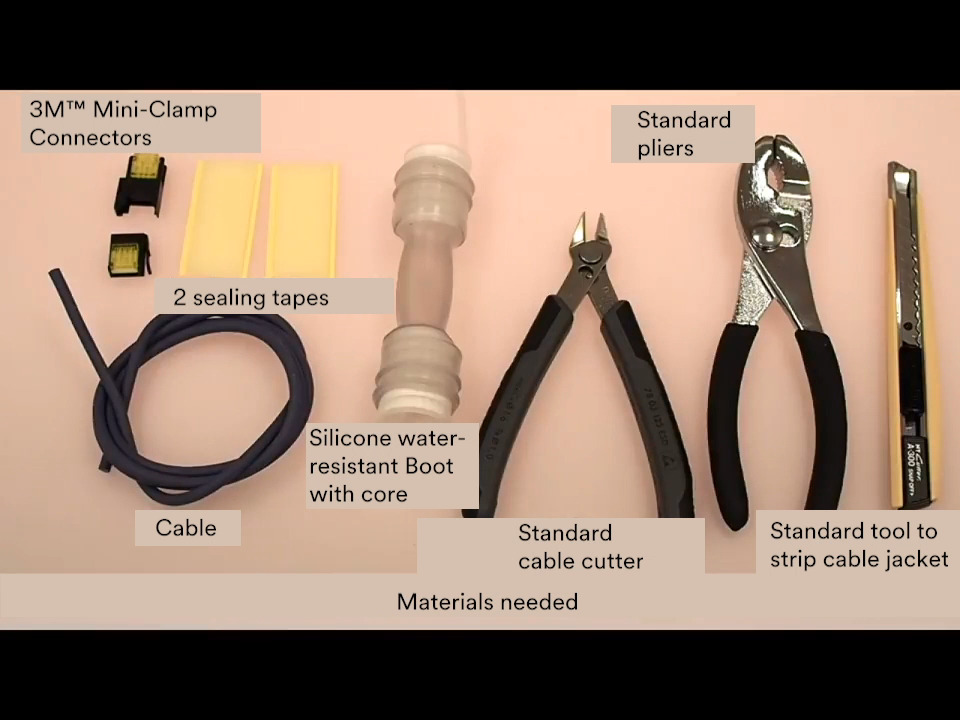
While many of the pain points in conventional wiring come from the number of steps involved, IDC’s underlying mechanism is simple. The insulated wire is pressed into a U-shaped slot that pushes aside the insulation and makes copper-to-copper contact. This eliminates stripping, tinning, and other pre-treatment steps. Many IDC designs also terminate several wires at once, rather than one at a time. They often employ semi-transparent covers or guide features to ensure that conductors are positioned correctly before the connector is closed. Some families incorporate an audible or tactile latch to indicate when the connection is fully seated. These features support repeatable results—while requiring no more than a standard pair of pliers for most field installations.
Because it removes several handling steps, IDC can reduce labor costs in equipment build and field work. In many applications, wiring time is shortened by as much as 60 to 80 percent, which becomes significant when spread out over dozens of connections. The simpler workflow also leaves fewer chances for incorrect strip lengths, missed strands, or crimps that do not fully seat. In 3M’s case, the copper used in the contact is chosen for its elasticity, to help create a high-quality connection between the wire and the channel. Because the insulation is displaced rather than cut away, there is no loose debris to manage, which is useful in clean manufacturing environments where stray fragments can be problematic. The compact pitches and controlled contact geometry found in many IDC families allow engineers to manage dense wiring more efficiently within tight layouts.
Top Applications for IDC Connectors
The following use cases illustrate where IDC connectors are a strong match for wiring requirements.
High-Density Sensor Networks
Semiconductor manufacturing tools and other precision machines implement huge numbers of sensors feeding into centralized control electronics. At times, there can be as many as thousands of terminations in one system. EV battery production equipment is similar, as automation expands and more sensing points are added within limited enclosures. In these environments, a connector that eliminates wire stripping and can terminate several wires at once helps shorten the time required for assembly and maintenance. The faster workflow is especially relevant for such systems where an hour of downtime can translate into hundreds of thousands of dollars in lost output.
Long-Run Distributed Systems
Material-handling equipment, conveyor systems, and automated warehouses stretch across long distances; in some facilities, these paths can run for miles. Sensors are placed at intervals along the line, with each sensing point connecting back to the control system. Traditionally, adding a new device meant pulling another cable all the way to a terminal block, regardless of where it was installed along the line.
IDC-based branching connectors offer a different approach. Instead of routing a separate home-run cable, a technician can splice into the main trunk line at the point where a new sensor is installed. IDC termination makes it possible to add a new node with only a few straightforward steps. By branching off the existing line, the amount of cable required drops, installation becomes simpler, and changes to the system layout are easier to accommodate.
Field-Maintained and Vibration-Prone Equipment
Some equipment is wired in places that are simply difficult to reach. Recreational vehicles are a good example: HVAC units, sensors, lighting systems, and entertainment electronics are all routed through narrow compartments, and constantly exposed to vibration once on the road. Industrial electronics, automation equipment and outdoor control panels also have much of their wiring tucked into awkward spaces. Technicians may be working in cramped settings, sometimes outdoors in the elements, and they often need to get a system back up and running without much delay.
IDC connectors lend themselves well to this kind of work. Because the wire does not need to be stripped and the termination is made with a single press, the process is easier to carry out during field service. Latching and polarization features available on some IDC families help keep the connection secure once the equipment is in operation, even under nonstop movement.
Debris-Sensitive Environments
Cleanroom processes used in semiconductor, LCD, and medical manufacturing place strict limits on anything that could introduce debris. Traditional stripping can leave behind insulation fragments or fine strands. Because IDC displaces the insulation rather than cutting it away, the termination does not generate loose scraps. Therefore, IDC connectors align well with applications that prioritize contamination control, without adding extra steps to the process.
3M’s IDC Connector Portfolio
To support this variety of applications, 3M offers several IDC connector families, each tailored to meet specific wiring needs.
Mini-Clamp Connector Series
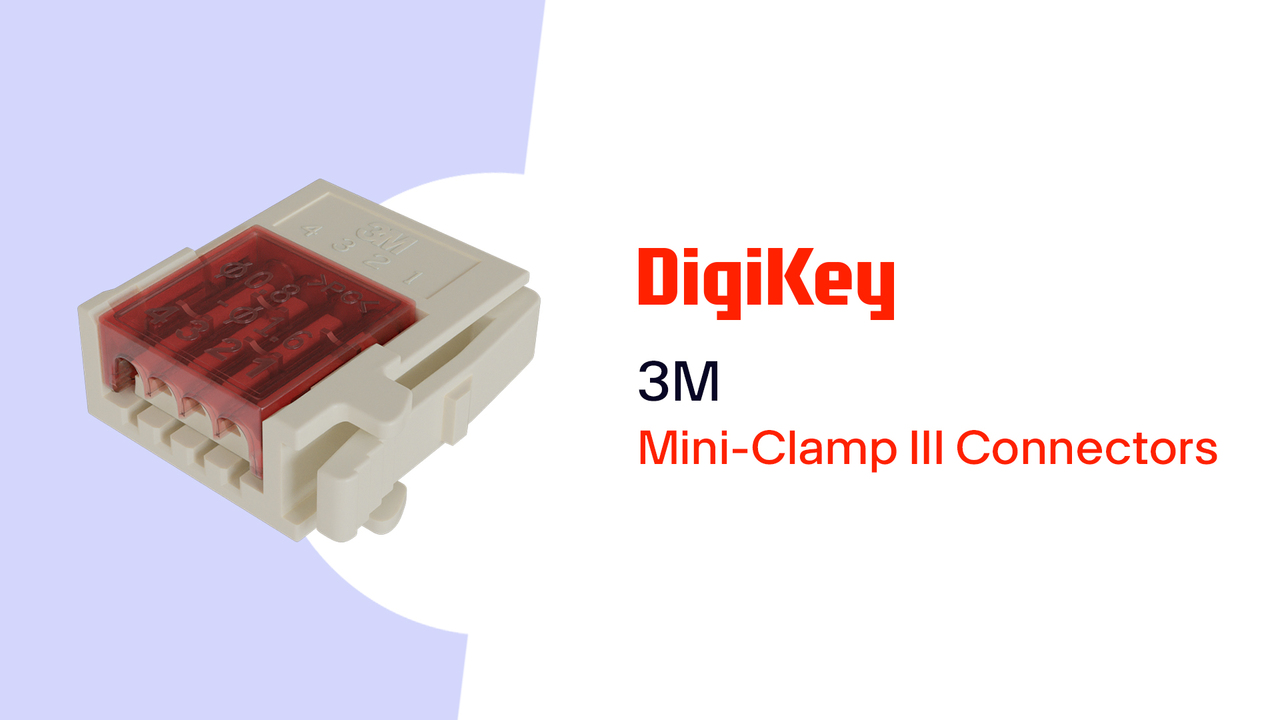
Mini-Clamp connectors are designed for compact sensor and signal wiring, with a 2 mm pitch that helps conserve space. They are well-suited for equipment that relies on many small-gauge conductors, using IDC to terminate three to eight wires at once. A transparent cover lets installers confirm wire placement, and the audible click when the connector seats fully is an effective quality check during assembly. Mini-Clamp supports 30–20 AWG wires and comes in wire-to-wire, panel-mount, and board-mount versions. Recent updates include improved wire-holding mechanics and a latch guard that keeps the connector from catching on other cables.
 Figure 1: Mini-Clamp connector series.
Mini Stack Connector Series
Mini Stack connectors address applications where PCB space is limited, offering a footprint that can free up roughly 30 percent more board area compared to Mini-Clamp. They use a double-IDC termination method and can terminate two to four wires simultaneously. The series supports 30–22 AWG wires. Terminals are integrated into the housing to simplify handling, and up to four sockets can be stacked into compact blocks for easy mating or unmating. Fixed tabs on the board-mount headers help keep the connector aligned during soldering.
 Figure 2: Mini Stack connector series.
Link Connector Series
Link connectors apply IDC technology to branching and splicing along existing wiring runs, making them particularly useful in distributed systems. Rather than pulling a new cable all the way back to a terminal block, a technician can create a T-branch directly on the trunk line, even mid-cable. The family supports 22–16 AWG wires and includes detachable hermaphroditic versions that mate with themselves. Compact one-piece options and an IP54 splash-resistant variant for environments that require added protection are available.
 Figure 3: Link connector series.
Power Clamp Connector Series
Power Clamp connectors are intended for more rugged applications where wiring must stay secure under mechanical stress. They support 20–18 AWG wires and are rated up to 250 volts and 10 A on a single contact, or 7 A across multiple contacts. Semi-transparent, color-coded covers assist with wire placement, while polarization and latching keep the connection locked in place during operation.
 Figure 4: Power Clamp connector series.
To learn more, visit 3M IDC Connectors.
Descargo de responsabilidad: Las opiniones, creencias y puntos de vista expresados por los autores o participantes del foro de este sitio web no reflejan necesariamente las opiniones, las creencias y los puntos de vista de DigiKey o de las políticas oficiales de DigiKey.