Configuración
 Entrega rápida
 Tipos de pago


 Producto del mercado


Integrating CO2 Sensing into Sleep Monitoring Applications
Good sleep is fundamental to physical health, cognitive performance, and emotional well-being, which is why many consumers use sleep-tracking applications to monitor patterns and trends over time. Yet most sleep products focus on what happens inside the body while overlooking the surrounding bedroom environment, where inadequate overnight ventilation can allow CO₂ to build up.
Several studies have associated elevated indoor CO₂ and inadequate bedroom ventilation with poorer sleep outcomes, including reduced sleep efficiency and changes in deep sleep. In sleep applications, CO₂ can serve as a useful indicator of rebreathed air and ventilation effectiveness, helping products connect environmental conditions with sleep-quality metrics.
For product designers, adding compact CO₂ sensing can help sleep-monitoring devices provide ventilation alerts, recommend room changes, trigger HVAC or air-purification responses, or correlate air quality with sleep outcomes. Small, low-power sensors make it practical to integrate this capability into discreet bedside, wearable, and smart-home products without disrupting the user.
Sensirion addresses this design need with compact CO₂ sensing options that scale from miniature, low-power components to multi-parameter modules. For sleep-monitoring products, these sensors can provide the environmental data needed to assess ventilation, support user-facing insights, and enable automated responses in connected bedroom systems.
Space-constrained needs
The STCC4 (Figure 1) is a small-form-factor, low-power CO₂ sensor suitable for integration in space-constrained, battery-powered applications where minimizing sensor size and power consumption are key priorities. Designed for high-volume assembly, it aims to remove size and cost constraints that have made CO2 sensing difficult to integrate into compact electronic devices, with a measurement accuracy of ±100 ppm plus 10% of the reading over a 400 to 5,000 ppm range.
 Figure 1: Sensirion's STCC4 aims to meet the size and cost constraints of high-volume consumer applications. (Image source: Sensirion)
With dimensions of 4 × 3 × 1.2 mm and a weight of approximately 0.02 g, the STCC4 has a small footprint intended for space-constrained designs. It utilizes thermal conductivity gas sensing to estimate CO2 concentration from changes in gas thermal properties. It can be paired with an external temperature and humidity sensor when applications require additional environmental data.
The STCC4 is also optimized for battery-powered and other low-power applications where energy efficiency is a primary design consideration, drawing approximately 950 µA in continuous measurement mode.
Broader performance and integration options
The SCD4x series offers a broader range of performance and integration options for applications where CO₂ measurement can be used to control ventilation and support monitoring against IAQ requirements, such as in HVAC controls, thermostats, air purifiers, IAQ monitors, and ventilation systems.
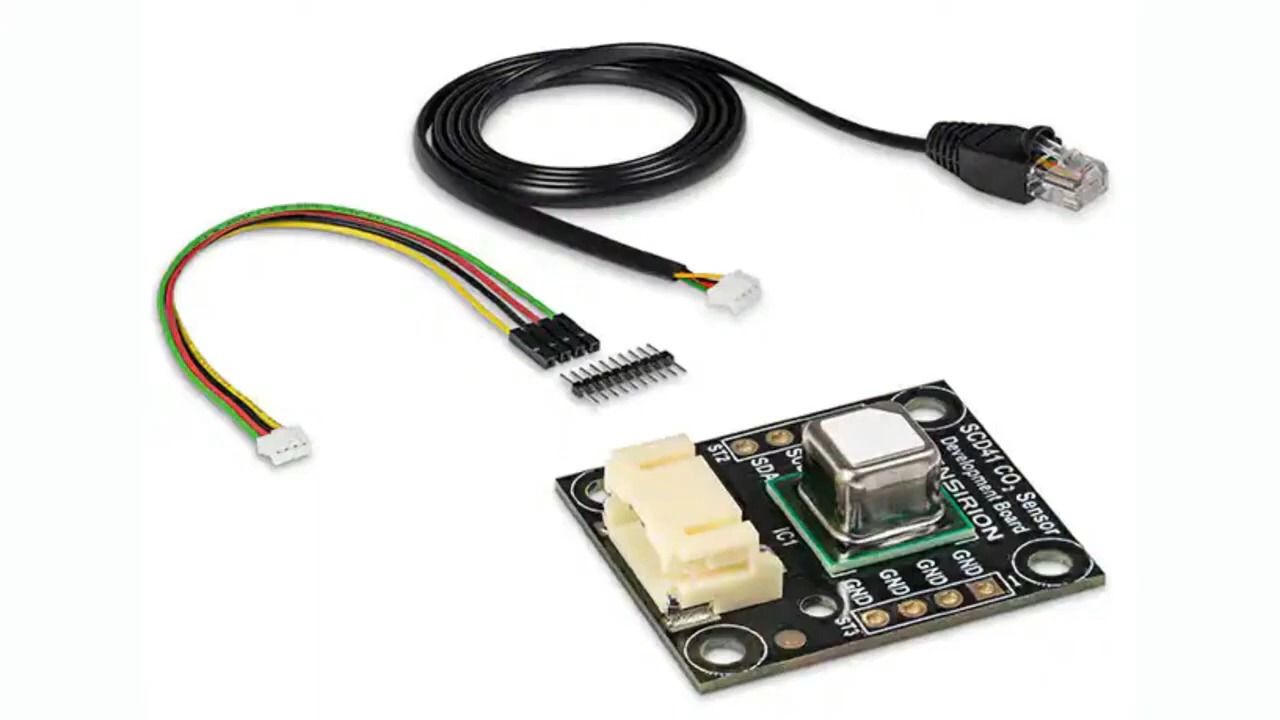
Unlike the STCC4, the SCD40-D-R2 (Figure 2) and SCD41-D-R2 sensors combine CO₂, temperature, and relative-humidity sensing in a single package, generating multiple environmental parameters for sleep-focused applications to take into account environmental conditions. Both SCD4x models have dimensions of 10.1 × 10.1 × 6.5 mm.
 Figure 2: The SCD40 sensor's CO2 measurement is suitable for general IAQ monitoring applications. (Image source: Sensirion)
Using the same photoacoustic CO₂ sensing technology and package, the two SCD4x models are optimized for different measurement requirements:
- The SCD40-D-R2 provides CO₂ accuracy of ±50 ppm plus 5% of the reading across 400 to 2,000 ppm, suitable for general IAQ monitoring applications.
- The SCD41-D-R2 extends the measurement range to 5,000 ppm and provides improved accuracy of ±40 ppm plus 5% of the reading, making it more appropriate for applications that require greater measurement precision or need to reliably measure higher CO₂ concentrations. It is also compatible with the WELL Building Standard, RESET Air Standard v2.0 Grade B, and California Title 24, making it more suitable for applications with higher measurement requirements or where compatibility with these building standards is crucial.
The SCD40-D-R2 and SCD41-D-R2 draw approximately 15 mA during continuous operation. However, the SCD41 offers low-power and single-shot modes that can reduce average consumption to about 3.2 mA in low-power periodic mode or 0.45 mA when taking a measurement every five minutes. This gives designers flexibility to balance measurement frequency and power consumption.
Conclusion
Indoor air quality is an important consideration for next-generation sleep-monitoring products. By integrating CO₂ sensing into sleep-focused devices and systems, designers can monitor air-exchange conditions and correlate environmental data with sleep metrics. Sensirion's STCC4 and SCD4x sensors provide a range of size, power, and functionality options to enable designers to add environmental monitoring capabilities across products from portable wearables to smart-home ventilation systems.
Acerca de este autor

Pete Bartolik is a freelance writer who has researched and written about IT and OT issues and products for more than two decades. He previously was news editor of the IT management publication Computerworld, editor-in-chief of a monthly end-user computer magazine, and a reporter with a daily newspaper.

Have questions or comments? Continue the conversation on TechForum, Digi-Key's online community and technical resource.
Visit TechForumMás blogs de este autor