Settings
 Fast Delivery
 Payment Types


 Marketplace Product

Hysteresis Hysterics - The Hidden Controls Scheme Behind Everyday Life
Hysteresis - The driving force that silently keeps you (and your wallet) from going INSANE!
Picture this: you get home from a long day working outside, walking around doing heavy yard work, and working up a sweat. You walk inside, and your apartment air conditioner is doing something extra weird, something it has never done before...
*Click - the air conditioner whirs to life.*
And just like that, before you realize it is on, it turns back off. And then suddenly it's back on. Weird.
"Oh well, it's probably nothing," you think as you walk over to the refrigerator. An ice-cold glass of iced tea sure sounds good, especially now that your air conditioner doesn't seem to be working right. You open the door, and the compressor in your fridge whirs to life and cycles on and off over and over and over again. It's cold, but not cold enough. Your energy meter is spinning feverishly with all the energy your appliances are using. What could have happened to your home?!
Your home lost its Hysteresis.
Now, obviously this tale of horror and terror is not really possible in the real world, but it makes you think - "what keeps our world moving so smoothly?" - "Do electrical engineers truly know everything?" - "Are they magicians?"
The answer is Hysteresis, or in other words, the control loop that overshoots and slowly releases control silently in everything from refrigerators, thermostats, air compressors, and even non-electrical examples such as your lungs and even world economics!
Having some hysteresis in our lives is what keeps things running smoothly, keeps devices running efficiently, and allows our devices to make decisions even when there's no one around.
Okay, but how does it work?
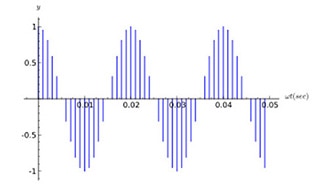
I actually really liked this graphic I found on the Typhoon HIL Documentation page. As you can see below, we have an input signal x(t) and an output signal y(t). The input is analog and AC, while the output is DC digital.

In this example, as soon as the x(t) blue wave crosses above the threshold, then and only then does the y(t) signal rise to the logic level HIGH. What is interesting is that the output stays HIGH even well after the x(t) input crosses below the midpoint and becomes low itself. It is not until the x(t) function crosses fully below the lower threshold that the y(t) function reflects that change and becomes low itself.
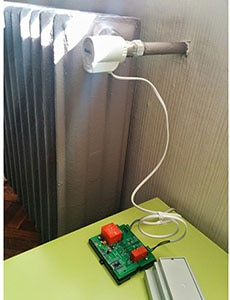
It's just like your thermostat! When you want to run the furnace or your air conditioner, the thermostat powers the device until it reaches the target or a little beyond. From there, it powers off the device until the temperature is back outside of the acceptable range and then decides to turn the appliance back on. x(t) is the temperature, and y(t) is your furnace or air conditioner status.
Okay, but what other examples are there?
There are so many examples of hysteresis across many disciplines. We just went over controls and systems examples, but what about material science?
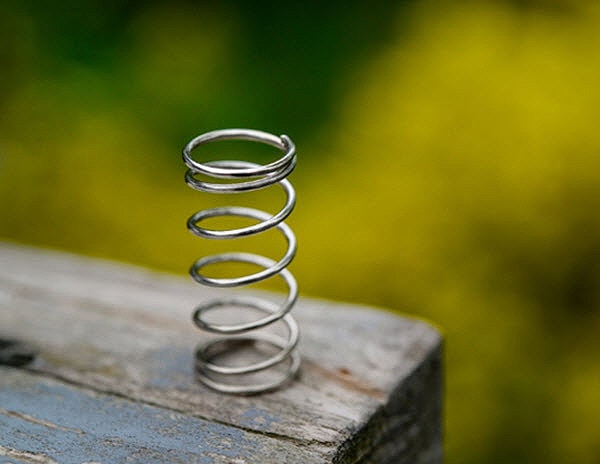
In metalworking, there is Hysteresis whenever you are working with steel. For fun, you can try this one at home. Pick up a paper clip and try to bend the paper clip open, but don't actually allow it to permanently deform. The paperclip will snap back to its original shape because of the natural hysteresis of the material and the fact that you did not overcome the break-over point.
Now, bend it farther. Notice how the paperclip will now continue to snap back to its new position. You have overcome its hysteresis, and now the natural hysteresis is holding the metal in equilibrium at its new form.
Another example is economics. We don't live in a world where one day there is a recession, and the next day there is prosperity. The world naturally moves along a hysteresis curve where we are drifting toward one and away from the other, but the same point that triggers recession is not the point that will trigger prosperity when moving the other way.
Final thoughts
While this blog only scratches the surface of everything that hysteresis can and does do in the world around us, what is important to me is that you may have learned how to apply this control theory to your own controls project. Who knows, maybe you also learned a new perspective on how to apply some engineering principles to non-engineering topics.
While I use hysteresis in my day-to-day job developing controls formulas for vehicles, I also understand its importance when I appreciate the air conditioner holding my house steady at the same temperature without having to constantly run my air conditioning unit.
Now that you understand how it works, see if you can find examples in your own life and see if you maybe can gain a new appreciation for what went into the design!